Excerpt from the First Part The Fall of Troy (1)
Excerpt from the Second Part The Fall of Troy(2)
IV. The Doom of Laocoon
“But what about the horse?” cried the crowd of Trojans, “What about the horse?”
“The horse,” said Sinon, “was built as the soothsayer, Calchas, had directed. Otherwise, the ships could never have sailed. There it is now, standing among the reeds. The soothsayers declared that it would carry happiness and prosperity and peace wherever it should go. But the Greeks were unwilling that it should ever do any good to Troy. Therefore they built it so wide and high that it cannot be taken through your gates. They placed it among the reeds by the shore, hoping that the waves might carry it to deep sea.
“Ah, that is their plan, is it?” cried the excited Trojans. “Well, we shall see whether Troy is not made happy and prosperous by such a piece of work. And, forgetting Sinon, the whole company, with the king’s officer at its head, rushed madly to the spot where the great horse stood.
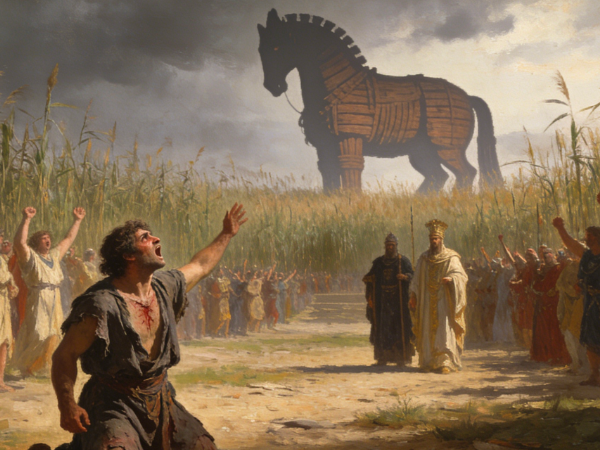
“Beware, my countrymen, beware!” cried the voice of old Laocoon, as he struggled through the crowd. “This is a trick of the Greeks. The horse will not bring you happiness and prosperity, but rather misery and ruin. Drive it into the sea, burn it to ashes, but do not receive it into the city.”
With these words he threw his spear at the huge image. The weapon struck it full in the breast, and those who stood nearest declared that they heard deep hollow groans and a sound like the rattle of shields coming from the throat of the monster.
“To the sea with it! To the sea with it!” cried a few who believed in the old priest.
But the greater number shouted, “To the city with it! To the city with it! We will prove ourselves cleverer than the Greeks!”
Some ran to the city for ropes and wheels, and others hurried to make an opening in the wall large enough for the monster to pass through.
The followers of Laocoon were too few and weak to object or resist; and the old priest, with his two sons as assistants, left the crowd and went out on the beach to offer a sacrifice to Apollo, as was the custom of his country. He had built an altar of smooth stones and was preparing the sacrifice, when fearful cries were heard among the people by the shore, and all fled away in terror. Laocoon, looking up, saw the cause of the alarm.
In the sea two huge snakes were swimming. They appeared to be coming from the island of Tenedos, four miles away, and they were approaching the beach with terrific speed. No doubt Laocoon thought they were common water snakes and would not come upon the land; for, after watching them a moment, he turned again to his altar and began offering the sacrifice. Swift as light the snakes moved toward the shore. Lifting their heads high in the air, they came out from the waves and crawled over the sandy beach. Before Laocoon saw his danger, the snakes had reached the altar. In another moment they had got the unfortunate priest and his sons, who fell down lifeless beside the altar they had built; and the snakes, as though satisfied with their work, moved away and hid themselves under some rocks where the Greeks had made a statue of Athene.
The Trojans, who had watched the dreadful scene from a distance, stood for a while speechless with fear, not knowing who might be the next victim. At length, seeing that the snakes remained hidden, they began to breathe more freely; and, as their courage slowly returned, some among them cried out, “Look how Athene has punished the man who dared to insult her by striking the great horse with his spear!”
“May such be the fate of all others who would oppose the will of the Gods!” cried a white-headed soothsayer. “Let us offer thanks to our protector, the wise and kind Athene; and let us draw her horse into the city. Then Troy shall be forever prosperous.”
Immediately the fears of the past hour were forgotten. All began to talk at the same time, and all were anxious to take the great horse to the city as soon as possible. Ropes were fastened to its neck and forelegs. Wooden wheels were placed under each corner of the platform on which it stood. Men with axes and hoes ran forward to clear a way across the plain to the place in the city wall where the opening had been made. Then the strongest seized hold of the long rope and began to pull. Others pushed against the platform at the back. Still others stood by and offered kind advice to the workers. Some prayed to Athene.
V. The Dreadful Surprise
At last, after a great deal of pulling and sweating by those at the ropes, the huge horse began to move, and every Trojan shouted so loudly that the sound was heard far out to sea.
Slowly but steadily the crowd advanced across the plain, dragging the wonderful horse which they believed would bless the city. The sun had set before they passed through the opening in the wall; and the darkness of night was beginning to fall when the wheels stopped. The great horse came to a standstill in a quiet corner close by the temple of Athene.
“My friends,” said the king’s officer, “we have done a fine day’s work. And Athene’s horse rests near the place where it shall remain. Now, indeed, the happiness of Troy is insured. Let every person go home! for tonight, the first time in ten years, we shall sleep in safety, fearing no foe.”
With joyful shouts and friendly good nights the crowd separated, and every man went quietly to his own house. Soon the city was wrapped in darkness, and the streets were silent and empty. And Athene’s horse stood motionless beside the temple wall.
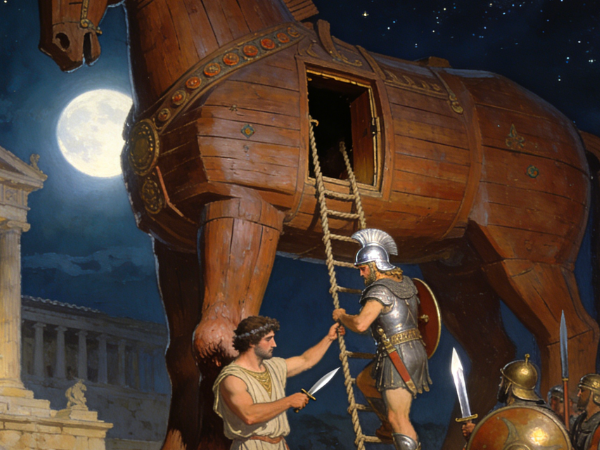
About midnight a man came stealthily out of the temple and made his way to the opening in the wall. In one hand he carried a basket of pitch. In the other a small torch which he had lighted at the temple fire. With great care he climbed to the top of the wall and waited. Soon the sky began to grow lighter and the shadows in the city less dark. Soon the moon rose, bright and round. The roofs of the houses, the broad top of the city wall, the dull, deserted plain, the silent sea — all were silvered over with her soft light.
The man on the wall looked eagerly toward the sea. What were those dark objects which he saw moving swiftly over the water and coming rapidly toward the shore? A thousand ships, driven by twenty thousand oars. The cunning Greeks had not started for home, as the Trojans foolishly believed. They had gone only to the island of Tenedos and had hidden there all day. Soon their ships would again return to their old places by the deserted camp.
The man on the wall seemed to understand it all. He lifted the torch and dropped it carefully into the basket of pitch. A flame arose. As it lighted up the plain and the outside of the wall, it shone also upon the face of the man. His eyes were red, his face was wounded and swollen, half of his left ear was gone. It was Sinon.
Lights were soon seen on the ships; and then Sinon hurried down to the spot where the great horse was standing silent in the moonlight. With his short sword, he struck its foreleg three times. There was a noise above as of the rattling of weapons. Then a door appeared in the horse’s breast. A man’s head, wearing a shining helmet, appeared at the opening.
“Is all well, Sinon?” asked a deep voice.
“All is well, Cousin Ulysses. Our ships are now come to the shore, and our friends are marching across the plain. The foolish Trojans lie sleeping in their homes, little dreaming of what awaits them.”
A rope ladder was let down, and Ulysses came down to the ground. Then fifty other heroes followed him, glad to be in the open air again.
“But, Sinon,” said Ulysses, “what mean those scars on your face, those half-blind eyes, and that bleeding ear? Did the Trojans abuse you thus?”
“They abused me, but they made not these wounds,” answered Sinon. “I made them myself, that I might the more easily persuade them to fall into our trap.”
“I understand, Sinon,” said Ulysses. “People call me a wise man, but that tide must now belong to you. And now for the ending of the whole business! Follow me, my men, and let fire and sword do their worst!”
Why should I tell the rest? The Trojans awoke from their dreams of peace to see their homes in flames, to hear the shouts of the victorious Greeks, to know that for them there was nothing but sorrow and death. Thus the long siege came to an end, and thus the fair, rich city beyond the Aegean Sea was overthrown.
—The End