Excerpt from the First Part The Fall of Troy (1)
III. The Deserted Camp
About the middle of the morning, the old king of Troy caused a proclamation to be sounded in the streets: —
“Our enemies have left, and peace and safety are ours once again. At noon the gates of the city shall be opened, and our people may resume their peaceful occupations.”
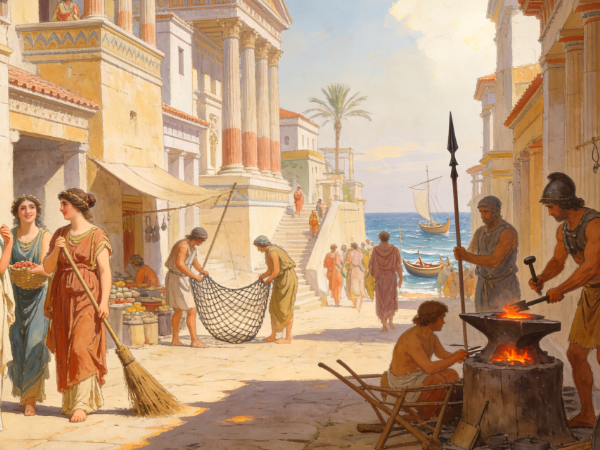
At once there was a great bustling and stirring in every corner of the city. It was as though day had dawned after a long and fearful night. How sweet it was to feel free from dread and to go about one’s business in peace. The women began to sweep and air their long-neglected houses, talking loudly and singing as they did their various tasks. The shopkeepers brought out their goods and announced fine bargains to the first buyers. The smiths kindled fires in their forges, and began to make old spears into farm tools and other implements of peace. The fishermen mended their nets. The farmers counted their rakes and hoes and ploughs, and talked about the fine crops they would have on lands that had lain idle so long.
But not all the people were thus busy preparing for the occupations of peace. Long before the hour of noon a great company of idlers and sightseers, soothsayers and warriors, half-grown boys, and indeed many respectable men, had gathered before the gate on the seaward side of the town, anxious to go out of the long-shut-up city. No sooner was the gate opened than there was a wild rush across the plain toward the shore. Men as well as boys were anxious to see whether the Greeks had left anything behind them that was worth having.
They wandered along the beach, looking in every corner of the old camp, but finding nothing more than a few bits of crockery, a broken sword hilt or two, and a few worthless ornaments. But they kept well away from the inlet where the reeds grew. The boldest of them could not be persuaded to go near the huge wooden horse which stood there. For Laocoon, the priest, had warned them again to beware of it; and so they stood at a distance and gazed at the strange, ugly object and wondered what evil trick the Greeks had intended by leaving it behind.
Suddenly on the other side of the camp a great shouting was heard. Then they saw some countrymen, who had been hunting in the marshes, approaching with a prisoner.
“A Greek! a Greek!” was the shout; and men and boys ran forward to see the prisoner. The poor fellow was led by a rope tied round his neck; and as he stumbled along over the sand, the rude crowd abused him and threw at him whatever objects they could lay hold of. Blood was streaming down his face, his eyes were swollen, his left ear was torn, and his right arm seemed useless. But the people, as they saw his condition, shouted only the louder, “A Greek! a Greek! Away with him.”
Then, all at once, the noise stopped and a great silence fell upon the beach; for, standing in his chariot quite near the spot, was one of the officers of the king.
“What prisoner is this whom you are thus abusing?” he asked.
“We think he is a Greek,” answered those who had captured him. “We found him in the tall grass by the marshes; and as he was already wounded and half blind, it was easy for us to take him, although we were unarmed.”
“Already wounded!” said the officer. “That is indeed strange.” Then turning to the prisoner, he asked, “How is this? Tell me whether you are a Greek or whether you are a friend of Troy. What is your name, and what is your country?”
“My name,” said the prisoner, “is Sinon, and although I am by birth a Greek, yet I have no country. Until ten days ago I considered myself a friend of Greece, and fought bravely among her heroes. But see these wounds, this ear, this bleeding face, these eyes. Can I remain friendly to those who thus treated me and would gladly have taken my life also?”
“Tell us about it,” said the officer; “and tell us truly if the Greeks have sailed to their homes never to return again.” And he motioned to the young men to loosen the rope about the prisoner’s neck.
“Yes, I will tell you,” answered Sinon, “and I will be brief. When Ulysses, the most clever of men stole the Palladium from your temple, the Greeks felt sure that the city would soon fall into their hands. But as day after day passed by, and they won not a single fight before the gates, they began to despair. Then a council was held, and it was decided to give up the siege and sail for home. Immediately great storms rose on the sea. The south wind blew continuously for days together. The waves dashed over the beach and destroyed more than one of our tents. It was impossible for any ship to go out to sea, and we all lay idle and despairing within our storm-beaten camp. Then the chiefs of the Greeks called the soothsayers and bade them tell what was the cause of these things, and by what means we should be able in the end to return home. Calchas was the first soothsayer to speak.
‘Athene is angry,’ he said, ‘because her statue, the Palladium, was stolen from her temple. That is why the storms rage so violently on the sea; and they will continue to rage until you do something to make up for the wrong that she had suffered.’
‘Tell us what we must do,’ said the chiefs.
‘You must make a statue of a horse and leave it on the shore as a token of your shame and repentance,’ answered Calchas. ‘Never can your ships return to Greece until that is done.’
“Then another soothsayer was called. Ulysses had instructed him what to say. ‘The ships of Greece,’ said he, ‘can never sail until a hero well known in the councils of the Greeks shall be sacrificed to Apollo.’
‘Who is the hero that must thus be sacrificed? asked the chiefs.
‘It is Sinon,’ answered the soothsayer. For that wicked man desired my death, being offended at me without cause.
‘I was at once tied up with ropes and shut up in a tent on the outskirts of the camp. I was told that at sunrise on the following day I was to die. But in the dead of night I broke the ropes and would have escaped unhurt if I had not been discovered by Ulysses. He attacked me as I fled from the camp, and with unpitying blows he gave me the wounds that you see upon my body. Yet in the darkness I got away from him and found shelter in the marshes by the shore. There I lay hidden until I saw the last of the ships sail away. But, as I was creeping out of my hiding place these rude fellows seized me and dragged me here. Now you can judge for yourselves whether I am a friend of the Greeks.”
Excerpt from the Third Part The Fall of Troy(3)

One thought on “The Fall of Troy(2)”