Many years ago there lived an Emperor who was so tremendously fond of fine new clothes that he spent all his money on being elegantly dressed. He took no interest in his army or the theatre or in driving through the country, unless it was to show off his new clothes. He had different clothes for every hour of the day and, just as you might say of a King that he was in the council-chamber, so it was always said of the Emperor:
“He’s in his wardrobe.”
There was plenty of fun going on in the city where the Emperor lived. Strangers were continually arriving, and one day there came two swindlers. They made out they were weavers and could weave the very finest stuffs imaginable. Not only were the colours and design unusually attractive, but the clothes made from their material had the peculiarity of being invisible to anyone who wasn’t fit for his post or who was hopelessly stupid.
“I say! They must be wonderful clothes,” thought the Emperor. “If I had some, I could find out which of my statesmen were unfit for their posts and also be able to tell the clever ones from the stupid. Yes, I must have some of that stuff woven for me at once.” And he paid down a large sum of money to the swindlers straight away, so as to enable them to start work.
And they did; they put up a couple of looms and pretended to be working, although there was absolutely nothing in the loom. They coolly demanded the most delicate silk and the finest gold thread, which they promptly stowed away in their own bags; and then they went on working far into the night at their empty looms.
“Well, now, I wonder how they are getting on with the work,” said the Emperor to himself. But there was one point that really made him feel rather anxious, namely, that a man who was stupid or quite unfit for his post would never be able to see what was woven. Not that he need have any fears for himself — he was quite confident about that — but all the same it might be better to send someone else first, to find out how things were going. Everyone in the city had heard of the mysterious power possessed by the material and they were all eager to discover how incapable or stupid his neighbour was.
“I’ll send my honest old Prime Minister to the weavers,” thought the Emperor. “He’s the best one to see what the stuff looks like, for he has plenty of sense and nobody fills his post better than he does.”
So off went the honest old Premier to the workshop where the two swindlers sat busy at their empty looms. “Lord bless my soul,” thought the Minister with eyes staring out of his head. “Why, I can’t see anything!” But he was careful not to say so.
The two swindlers begged him to take a closer look — didn’t he find the colours and design most attractive? They then pointed to the empty loom but, although the poor old Minister opened his eyes wider and wider, he couldn’t see a thing; for there wasn’t a thing to see. “Good Lord!” he thought, “Is it possible that I’m stupid? I never suspected that, and not a soul must hear of it. Can it be that I’m unfit for my post? No, it will never do for me to say that I can’t see the material.”
“Well, what do you think of it?” asked the one who pretended to be weaving.
“Oh, it’s charming! Quite exquisite!” said the old Minister, looking through his spectacles. “What a pattern and what colouring! I shall certainly tell the Emperor how pleased I am with it.”
“Ah, we’re glad to hear that,” said the swindlers, and they then gave details of the colours and the peculiar design. The old Minister listened carefully, so as to be able to repeat all this when he came back to the Emperor — which he duly did.
The swindlers now demanded more money, more silk and more gold thread, for these would be required for weaving. They put it all into their own pockets — not a thread came into the loom — while they went on working the empty frames as before.
By and by, the Emperor sent another honest official to see how the weaving was getting on and whether the stuff wouldn’t soon be ready. The same thing happened to him as to the Minister: he looked and looked but, as nothing was there but the empty looms, he couldn’t see anything.
“There, isn’t it a handsome piece!” said the swindlers, as they pointed out the beauty of the design which wasn’t there at all.
“I know I’m not stupid,” thought the man, “so it must be my fine position I’m not fit for. Some people might think that rather funny, but I must take good care they don’t get to hear of it.” And then he praised the material which he couldn’t see and assured them of his delight in its charming shades and its beautiful design. “Yes, it’s quite exquisite,” he said to the Emperor, when he got back.
The splendid material became the talk of the Town. And now the Emperor himself said he must see it while it was still in the loom. Quite a throng of select people, including the two honest old officials who had been there already, went with him to where both the crafty swindlers were now weaving for all they were worth without the vestige of a thread.
“Look, isn’t it magnificent!” said the two honest officials. “If your Majesty will but glance — what a pattern, what colouring!” And they pointed to the empty loom, feeling certain that the other could see the material.
“What’s this?” thought the Emperor. “I can’t see anything — this is appalling! Am I stupid? Am I not fit to be Emperor? This is the most terrible thing that could happen to me … Oh, it’s quite wonderful.” he said to them; “it has our most gracious approval”. And he gave a satisfied nod, as he looked at the empty loom; he wasn’t going to say that he couldn’t see anything. All the courtiers who had come with him looked and looked, but they made no more of it than the rest had done. Still, they all said just what the Emperor said — “Oh, it’s quite wonderful!” —and they advised him to have some clothes made from this splendid new material and to wear them for the first time in the grand procession that was shortly taking place. “Magnificent!” “Delightful!” “Superb!” were the comments that ran from mouth to mouth; everyone was so intensely pleased with it. On each of the swindlers the Emperor bestowed a knighthood, with a badge to wear in his button-hole, and the title of Imperial Weaver.
On the eve of the procession the swindlers sat up all night with something like twenty lighted candles. People could see how busy they were finishing off the Emperor ‘s new clothes. They pretended to take the stuff off the loom, they clipped away at the air with huge scissors, they worked at their needles without thread, and at last they announced: “There! The Emperor’s clothes are ready!”
Then the Emperor, with his most distinguished gentlemen-in-waiting, went in person to the weavers, who each put out his arm just as if he were holding something and said: “Here is the Mantle!” And so on. “They are all as light as gossamer; you can hardly feel you have anything on — that’s just the beauty of them.”
“Yes, indeed,” answered the gentlemen-in-waiting. But they couldn’t see a thing, for there wasn’t a thing to see.
“Now will your Imperial Majesty be graciously pleased to take off your clothes?” said the swindlers. “Then we can fit you with the new ones, there in front of the big glass.”
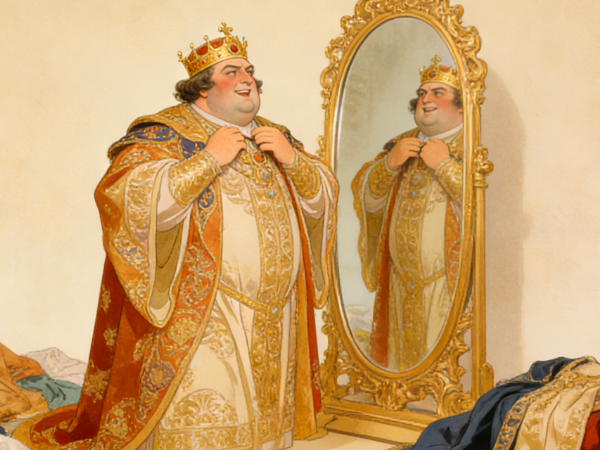
So the Emperor took off the clothes he was wearing, and the swindlers pretended to hand him each of the new garments they were supposed to have made, and they took him by the waist as if they were fastening something on … it was the train, and the Emperor turned and twisted in front of the looking-glass.
“Goodness! How well they suit your Majesty! What a wonderful fit!” they all exclaimed. “What a cut! What colours! What sumptuous robes!”
The Master of Ceremonies came in with an announcement. “The canopy to be carried above your Majesty in the procession is waiting outside.”
“All right, I’m ready,” said the Emperor. “Aren’t they a nice fit!” And he turned round once more in front of the glass, for he really had to make them think he was gazing at his fine clothes.
The chamberlains who were to carry the train groped about on the floor as if they were picking the train up; and, as they walked, they held out their hands, not daring to let it be thought that they couldn’t see anything.
There marched the Emperor in the procession under the beautiful canopy, and everybody in the streets and at the windows said: “Goodness! The Emperor’s new clothes are the finest he has ever had. What a wonderful train! What a perfect fit!” No one would let it be thought that he couldn’t see anything, because that would have meant he wasn’t fit for his job, or that he was very stupid. Never had the Emperor’s clothes been such a success.