A Folktale of the North-American Indians
Long, long ago, in the time when only a few people lived on the earth, there was a tribe of fishermen. In summer they travelled far to the North where they found good fish in abundance. But in winter they had to return to the warmer part of the country because the ruler of the North, a fierce old man whose name was Kabibonokka, or the North Wind, drove them away.
One morning, when they got up, they saw that thin ice had covered the water of the lake where they set their nets. Soon it began to snow and the ice grew thicker. The fishermen could already hear Kabibonokka’s steps in the distance.
“Kabibonokka is coming!” cried the fishermen. “Kabibonokka will soon be here. It is time for us to go.”
But Shingebis, one of the fishermen only laughed.
“Why should I go?” he said to his comrades, “I can cut a hole in the ice and fish with a line. What do I care for old Kabibonokka?”
They looked at him with astonishment. Of course they knew that Shingebis was a very clever man. But how could this help him against the terrible North Wind?
“Kabibonokka is much stronger than you,” they said. “The biggest trees in the forest bend before him. The swiftest rivers freeze at his touch. If you cannot change yourself into a bear, or a fish, he will freeze you to death.”
But Shingebis only laughed.
“My fur coat and mittens will protect me in the day-time,” he said, “and a warm fire burns in my wigwam at night. Let Kabibonokka come into my wigwam if dares!”
The fishermen were sad when they were going away. They all loved Shingebis, and the truth is, they did not expect to see him again.
When they had gone to the South, Shingebis fell to work. He prepared many large logs, gathered dry bark and twigs, and every evening the fire in his wigwam burnt brightly. In the morning he went to the lake, made holes in the ice and caught fish. In the evening he went home along a path in the snow, dragging a long string of fish.
“Whoo, whoo!” cried the North Wind. “Who dares to stay here long after the wild goose and duck have gone to the South? We shall see who is master in the Land of Ice. This very night I shall come into his wigwam and put his fire out! Whoo, Whoo!”
Night came. Shingebis sat in his wigwam by the fire. And what a fire it was! Each log was so big that it could burn for a month! Shingebis was cooking a fish — a big fresh fish which he had caught that very day. The fish smelt very nice, and Shingebis rubbed his hands with pleasure. He had walked many miles that day and it was good to sit by the fire in the warm wigwam. He was thinking about his comrades who had left for the South.
“They think that Kabibonokka is an evil manito,” he was saying to himself, “and that he is stronger than any Indian. It is true that I can’t stand cold as he can, but he surely cannot stand heat as I can.”
This thought made him merry, and he again began to laugh and sing. He ate his supper and did not even notice the noise that the North Wind was making in the forest around the wigwam. The snow fell thick and fast; near the ground the wind caught it up and drove it against the wigwam. But the snow did not get into the wigwam and only covered it like a thick blanket, protecting it against the cold wind.
Kabibonokka was quite furious. He stood near the entrance of the wigwam and shouted. His voice was wild and terrible, but Shingebis was not afraid. It was so quiet in that great silent country that he even liked the noise for a change. He laughed and shouted back.
“Ho, ho! How are you, Kabibonokka? If you are not careful, you will burst your cheeks.”
The wigwam shook with the force of the wind and the leather curtain that covered the entrance flapped with a great noise.
“Come in, Kabibonokka!” called Shingebis merrily. “Come in and warm yourself. Don’t be afraid!”
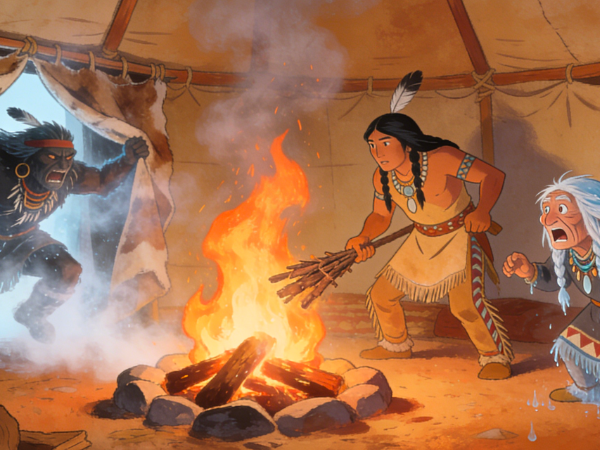
At these mocking words Kabibonokka gathered all his force, broke one of the leather straps of the curtain and made his way inside. Oh, how cold was his breath! So cold that it filled the hot wigwam like a fog.
Shingebis pretended not to notice. Singing a song, he rose to his feet and threw another log on the fire. It was a big pine log and it gave so much heat that he had to sit a little distance away. He looked at Kabibonokka, and what he saw made him laugh again. Sweat was pouring from the old man’s forehead, the snow and icicles in his hair quickly disappeared. Kabibonokka, the fierce North Wind, was melting! His nose and ears became smaller, and even his body was growing smaller.
“Come up to the fire,” said Shingebis. “Come up closer, and warm your hands and feet.”
But Kabibonokka, the North Wind, was afraid to come up to the fire. He jumped up and ran out of the wigwam faster than he came in.
The cold air made him stronger, and all his anger returned. He could not freeze Shingebis, so he spent his anger on everything around him. The snow under his feet became hard, the trees trembled under his breath and all the wild animals tried to hide themselves.
Once more Kabibonokka came to the wigwam of Shingebis.
“Come out,” he shouted, “come out, if you dare, and wrestle with me here on the snow. We’ll soon see who is master in the Land of Ice!”
Shingebis thought a little. “The fire must have made him weaker. And my own body is warm. I believe I can wrestle with him. When he sees that I am stronger, he will leave me alone, and I shall stay here as long as I please.”
He ran out of the wigwam, and then a great struggle began. They rolled over and over on the hard snow, then got up and fell again.
All night long they wrestled and Shingebis did not suffer from the cold because he moved all the time and this made his blood run quicker. He could feel that Kabibonokka was growing weaker and weaker; his icy breath was no longer a strong wind but only a sigh.
At last, when the sun rose in the East, Kabibonokka was conquered. With an angry cry, he turned and ran away. Far, far to the North he ran, to the very top of the world. And Shingebis stood near his wigwam and laughed loudly and merrily for he knew that cheerfulness and courage could conquer even the fierce North Wind.