Once there lived an old man and his wife. They were a gentle couple, who were happy together except for one thing — they had no children. For years they had hoped for a child of their own, but fate seemed against them. Now they were too old.
One fine summer morning the old man set out for the mountains to cut wood for the fire, and his wife took their winter kimonos and went down to the river to wash them. The river was gay that morning, the little waves dancing and laughing over the stones. The sun shone down warmly, and the old woman sang to herself as she worked.
She was on her knees rubbing away at the kimonos, when she looked up, and saw a big peach floating down the river. It was the biggest peach she had ever seen — as big as a rock.
‘Well,’ she said, in surprise. ‘Look at that huge peach! How my dear husband would enjoy that for his dinner.’
Picking up a long stick she managed to pull the peach towards the bank, where she could reach it. Then she picked it up, and carried it home.
When the old man came home he was very pleased to see the big peach.
‘Let us cut it open and taste it at once, wife,’ he said, ‘I am so hungry after my work on the mountain slopes. Come, give me the knife.’
But, to their surprise, when the old man cut the peach into two, instead of a stone in the centre, there was a baby. As the peach fell apart, the baby began to cry and the old woman at once picked him up, and kissed him.
‘Look at him, look at this dear little baby boy! Isn’t he lovely,’ she cried happily. ‘He must be a gift from heaven, because we have no children of our own.’
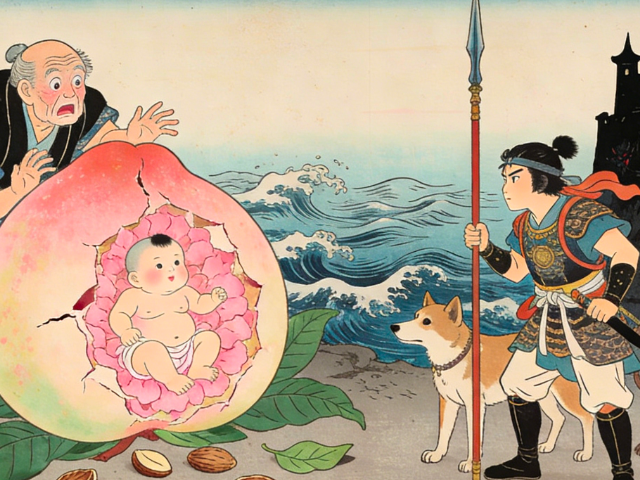
The old man agreed and they decided to look after the baby, as if he were their own son. As he was born in a peach, they named him Momo-Taro or the Peach Boy.
Momo-Taro lived happily with the old couple and was like a son to them. As he grew up, he became a strong and brave boy. He liked to listen to his father telling him the old stories of the brave warriors of Japan, and he decided that when he became a man, he would have exciting adventures.
At last, when Momo-Taro was fifteen, a stranger came to the village. He was a pedlar, who travelled from village to village, selling his needles and thread and cloth. He always had stories to tell, and this time he told the story of an island of devils. They come ashore by night, and carry off people from their homes. I have heard,’ said the pedlar, ‘that their castle is full of treasure — all the gold and jewels they have stolen. Many warriors have tried to defeat them, but they have failed. The devils are too strong and terrible for them. The walls of their castle are too high. They cannot be climbed without ladders, and the devils are careful guards. They are terrible creatures with horns and bushes of red hair. The man who defeats them will be a great hero!’ Momo-Taro sat and listened to this story with the other boys of the village. He thought about it for days, and at last he went to his parents. ‘I must go to the island of the devils,’ he said. ‘I am fifteen now and it is time that I left home and set out to find an adventure.’ At this, the old woman cried and moaned in despair at the thought of losing her son, but the old man was angry with her. ‘Be quiet, woman,’ he said. ‘Momo-Taro is right. Every young man must leave home to find his fortune. He is young and strong. I believe he will come home as a hero.’ ‘Go, my son, and our good wishes go with you.’ Then the old woman dried her tears, and made Momo-Taro a bag of her best rice-dumplings to eat on his journey.
Momo-Taro said goodbye to his parents, and set off along the road to the island of devils. He had not gone far when he met a dog. It was a very large dog, almost as large as a young horse. The dog came running up to Momo-Taro, showing his teeth, and looking very fierce. This is my country and my road! You are very rude not to ask before walking here! If you leave me all the things that you are carrying in that bag, you may go. Otherwise I shall bite you hard! Momo-Taro only laughed and said, ‘What are you saying, dog? Are you trying to frighten me? Don’t you know that I am Momo-Taro , the Peach Boy, and that I am on my way to fight the devils on the island? If you try to stop me I’ll break you into two, and throw the pieces to the birds.’ The look on the dog’s face changed at once. He bowed low and said, ‘Are you indeed Momo-Taro? Please forgive my rudeness. I am sorry. If you are going to the island of the devils, may I please go with you? I am a good dog in a fight.’ Momo-Taro replied, ‘If you wish to come with me you are welcome. I shall be glad of your help, to fight the devils.’ By the way,’ said the dog, as they started to walk on together. ‘What do you have in your bag?’ ‘These are the best rice-dumplings in Japan,’ said Momo-Taro. ‘My old mother made them for me to eat on the journey.’ ‘May I have one, too?’ asked the dog. ‘Of course,’ said Momo-Taro, and they went on together down the road, eating rice-dumplings. After a while, they heard a voice calling from above their heads.
Momo-Taro, Momo-Taro! Where are you going this fine day?
They stopped and looked up. Momo-Taro saw a monkey swinging on the branch of a tree.
I am going to fight the devils on the island,’ said Momo-Taro. What are you carrying in that bag?’
These are the best rice-dumplings in Japan.’
If you’ll give me one, I’ll come with you and help to fight the devils,’ said the monkey.
So Momo-Taro gave the monkey a rice-dumpling, and they all walked on together.
A little further along the road, they met a pleasant picking up corn from the dust, at the side of the road. He had very sharp claws and a long tail.
‘Hallo,’ said the pleasant. ‘Momo-Taro, where are you going with the dog and the monkey? And what are you all eating?’
‘We are going to fight the devils on the island,’ replied Momo-Taro.
‘And we are eating the best rice-dumplings in Japan,’ said the dog and the monkey, with their mouths full.
‘If I can have one too, I’ll come with you and help,’ said the pleasant.
‘Very well,’ answered Momo-Taro and he gave the pleasant a rice-dumpling.
Then the four friends walked on. At last they reached the coast. They could see the island of the devils in the distance. On the highest hill was a great black castle. Huge waves crashed against the rocks around the island.
Momo-Taro found a boat pulled up on the beach, and he and the dog pushed it down to the water. Then, with the dog looking out for rocks, and the pheasant telling them which way to go, Momo-Taro and the monkey rowed across to the island.
By the time they reached the island it was evening. The waves were very rough, and it was only with difficulty that they managed to climb out of the boat. They stood looking up at the high walls of the castle.
‘We must take them by surprise,’ said Momo-Taro. ‘Pheasant, you fly over the wall and unlock the gate. We will creep in quietly and hide until morning. Then, when the sun comes up, before the devils are all awake, we will attack them.’
The others thought this a very good plan. The pheasant flew over the great black walls of the castle, and unlocked a little gate. Then Momo-Taro, the dog, and the monkey crept through and hid near the hall, where the devils were sleeping. They took it in turns to sleep and to watch, until morning.
As the sun rose into the sky, the first devils came out, yawning and stretching in the morning air. They looked terrible creatures, with bushes of red hair, great horns, and spotted skin trousers.
‘Now!’ cried Momo-Taro, and with loud war-cries, the four friends fell upon the devils.
Because they had eaten the best rice-dumplings in Japan on their journey, they were now a thousand times stronger and braver than the devils. Momo-Taro threw them across the castle, the pheasant scratched their eyes out and the dog bit off their heads.
As for the monkey, he was everywhere, scratching and biting and throwing the devils around. The battle was fierce all over the castle but the four warriors had the advantage of surprise and they were so strong that the devils had no chance. At last all the devils had been killed except for their chief, who took off his horns, and gave them to Momo-Taro as a sign of defeat. He bowed down, and said, ‘Please don’t kill me. If you will let me live, I will give you all my treasure.’ Momo-Taro laughed, ‘It is useless to ask for mercy, evil devil — you have hurt and killed too many people, for too long. I shall take all your treasure, and deliver you to the Emperor for punishment. You will pay for your crimes with your life!’ Momo-Taro put the monkey in charge of the chief devil; the hen unlocked all the doors and he let out the prisoners. They were so grateful to be free again that they bowed before Momo-Taro and thanked him for giving them back their freedom. Then Momo-Taro collected together all the devils’ treasure — the gold and silver and jewels — and they all set off for home in one of the devils’ ships. Momo-Taro was now a hero. The emperor thanked him for defeating the devils on their island, and he arrived home with enough treasure to make his parents rich. The dog, the monkey and the pheasant remained his friends, and they all lived in peace and happiness to the end of their days.