The young prince of Denmark was once the happiest young man in the country, but a great trouble came into his life. His father died suddenly in a mysterious way, so that Hamlet became very sad and upset. Hamlet was told that the old King had died from the bite of a snake when he was asleep one afternoon in the garden. Soon after his death, Claudius, brother of the dead King and uncle of Hamlet, married the Queen and now was the King.
Hamlet did not love his uncle and it troubled him to think that his mother had married such a man. He slowly began to wonder whether Claudius had caused his father to be killed in order that he himself might become King, and whether his mother had known all about it — and this last thought drove him nearly mad.
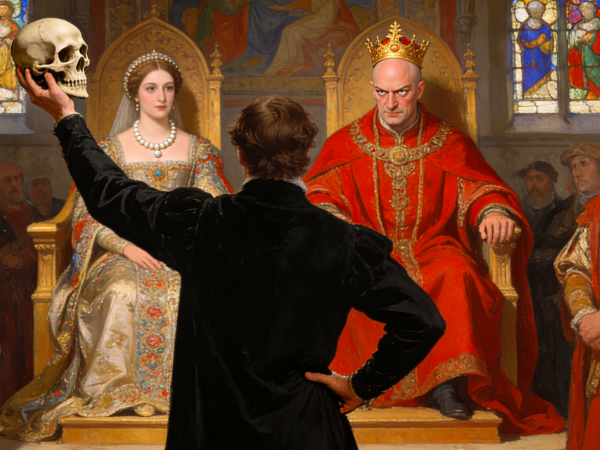
The new King and Queen noticed that the prince was dull and unhappy. They did not realize he suspected them of a terrible crime, so they tried hard to cheer him up. But although they advised him to dress and behave more cheerfully, he would not do so. At last they decided it was the result of his being in love.
At this time a strange story was told to Hamlet. For three nights the guards of soldiers in front of the castle had seen a ghost. Hamlet’s best friend, Horatio, had also seen it and brought the news to the prince. The ghost had appeared in the middle of the night. It was dressed just like the old dead King, and its face was just like his face. It wore a sad look, and when the guard had spoken to it, it had not answered, though once it seemed about to speak when the sun rose and it disappeared. Hamlet questioned the soldiers, and from their answer he felt sure that the story was true, so he determined to sit up next night and watch for the ghost.
On the next night, Hamlet, Horatio, and one of the soldiers met at midnight in front of the castle. As they stood listening, Horatio suddenly touched Hamlet on the shoulder.
“Look, my lord,” he whispered, “look, it comes.” The ghost had come again.
When Hamlet saw how like the dead King the ghost was, he asked him, “What does your coming mean, you, who are so like my father? Are you really he, or another? What do you want me to do?”
In answer the spirit made a sign for Hamlet to go aside with it, away from his two companions. He followed the spirit, which was truly his father’s ghost, which quickly told him that he had indeed been murdered by Claudius. The spirit then commanded Hamlet to revenge this terrible murder. So, telling Hamlet to forget its command, the old King’s spirit disappeared.
Returning to his friends, Hamlet made them promise to say nothing of what had happened that night; to Horatio he spoke of his talk with the ghost. He made up his mind to do a strange thing: he would in future behave like a madman for in that way he thought his uncle would be most unlikely to suspect him.
Hamlet’s talk and behaviour, therefore, became stranger than ever, especially when he was with the King and Queen. Weeks had passed since his father’s death, and yet the Prince did not seem to get any better, but rather worse, and his uncle and the Queen could not understand what was the matter.
Among those at court was an old man famous for his experience and wisdom, named Polonius. Polonius had a beautiful daughter, named Ophelia, whom Hamlet had liked very much at one time. Polonius had always hoped that Ophelia would marry Hamlet one day and become a princess, but he was not certain whether Hamlet truly loved Ophelia. Being very clever, he told Ophelia that if she sometimes appeared unfriendly to Hamlet, he would love her more.
Ophelia did as he advised. The result seemed to be just what Polonius had wanted. For soon afterwards his daughter came to him, telling him that Hamlet had been to see her, badly dressed, and with a look of sorrow on his face. Polonius at once thought Hamlet was unhappy because Ophelia did not love him, and he felt sure that this was the cause of all Hamlet’s madness.
Hamlet was always thinking of the command of his father’s ghost to revenge his cruel murder, and he continued to wonder how he could plan the revenge. One day he wrote a wild love-letter to Ophelia. She showed it to her father, who read it to the King and Queen, and then they agreed that the reason for the Prince’s madness had been found.
Poor Hamlet could not decide whether the ghost’s story was really true. He made up his mind to find out the truth — whether the King and Queen had really planned the murder, and he soon thought of a way to do this. For it happened that a party of wandering actors came to the castle and wanted to perform one of their plays before the Court. Hamlet had seen them before and remembered that one of their plays told of the terrible murder of a duke and of the sorrow of his duchess. He asked one of the players if he knew a play called “The Murder of Gonzago” in which a duke named Gonzago was poisoned in his garden by a near relation who afterwards married his widow. The actor said they knew it and would act it if Hamlet wished. “Tomorrow night,” said Hamlet, “you shall play it before the King and Queen, but I wish to put in a few lines of my own to improve it.”
So Hamlet made some changes in the play, in order that it might be as like the real murder of his father as possible. He therefore invited King Claudius and the Queen to come and see the play the next evening. And he went to his friend Horatio, told him what had been arranged, and asked him to watch the King and Queen closely.
When it was time for the play to begin the royal party entered and placed themselves in front of the stage. Hamlet and Horatio sat a little to one side in the shade, where they could watch the King without being seen themselves. At the beginning of the play the duke Gonzago and his wife were seen talking together, and she promised him that she would never marry again if her husband died. “Only those women marry a second husband who have killed the first,” she said, and at the words Hamlet saw his mother grow pale. The play was beginning to have its effect on the guilty pair. But what followed worried them even more. In the next scene the duke Gonzago was shown asleep in his garden, and a man came quietly up to him and poured poison into his ear as he slept. The guilty King was greatly upset by what he saw. Hamlet came and explained the play to him, saying, “He is poisoning Gonzago in order to get his lands for himself. The next scene shows where he wins the love of Gonzago’s wife.”
At this Claudius showed every sign of fear; he got up quickly, and he and the Queen ran from the room.
All the people there were extremely surprised, but Hamlet and Horatio had seen enough to be sure that the ghost had spoken truly and that the murder had been done. Hamlet saw now that it was his duty to revenge his father. At that moment a messenger came from the Queen saying that she wished to speak to him at once and privately.
King Claudius had persuaded the Queen to send for Hamlet. He wished to find out how much the Prince knew.
Meanwhile the Queen, who was waiting for her son, had made old Polonius hide behind the curtains in her room so that he should hear anything that Hamlet said. When Hamlet entered the room, the Queen began to blame him for what he had done. “You have offended your father very much,” she said.
Hamlet, thinking of his beloved father who was dead, replied angrily. “No, mother, it is you who have offended my father.” He had decided not to kill his mother, but he was determined to make her say that she was guilty, so he seized her roughly by the wrists to make her sit down. She was frightened and cried out. “What, will you murder me? Help! Help!” At this the old man, hidden behind the curtains, also thought Hamlet meant to kill his mother and called out as she did, “Help! Help! Help!” Hamlet thought it was the King and ran his sword through the curtains and the body of old Polonius as well, killing him at once. The Prince was not very worried by this, but the Queen cried out, “Oh! what a cruel and foolish deed you have done.” Hamlet answered, “Almost as cruel, mother, as to kill a king and marry his brother!” Meanwhile the King had determined to kill Hamlet. He planned to send Hamlet to the English court and to have him murdered when he landed in England. But Hamlet learned the plot, escaped and returned to Denmark. As soon as he was safe on land he sent a letter to Horatio asking him to come as quickly as possible. When they met, Hamlet told him what had happened to him. As they were going home they met two grave-diggers digging a new grave. They were told it was for a woman who had just died, and as they stood talking together the burial party arrived. Hamlet and Horatio were astonished to see among the people the King and Queen and other high persons of the court, including Laertes, the brother of Ophelia. Hamlet and Horatio hid themselves and watched as the priest held the service. Then they saw the Queen place some flowers on the grave and say sadly that she had hoped the dead woman would have been Hamlet’s wife.
On hearing this Hamlet suddenly realized that the dead woman was his dear Ophelia. He almost fainted with grief and, seeing Laertes jump down into his sister’s grave, he rushed out, too, and jumped into the grave beside him. Ophelia had been made unhappy by her lover’s strange behaviour, and when she heard that her father had been killed by him, she went mad and drowned herself. Laertes thought Hamlet was to blame and tried to fight with him, in poor Ophelia’s grave. The attendants parted them and Hamlet went away with Horatio, crying that he loved Ophelia far more than a brother could.
The wicked King was still determined to kill his nephew, so he thought of another plan. Knowing that Laertes and Hamlet were both clever swordsmen, he arranged for a match between them. Laertes was thought to be a better swordsman than Hamlet and the King persuaded him to use a sharp-pointed sword (which was forbidden in matches) and to put poison on it, so that Hamlet would almost certainly be killed. Hamlet thought that it was to be just a friendly match and he accepted.
But as the previous plan to kill Hamlet had not succeeded, the king was determined that this one should do so. He therefore placed two bowls of wine near him on the table at the place where the match was to take place, and in one of the bowls he placed a deadly poison, planning that he would drink to Hamlet’s success during the match and give Hamlet the bowl of poisoned wine to drink. Thus Hamlet would be sure to die, either form the poisoned sword or the poisoned wine.
The day for the match came and Hamlet and Laertes started to fight in a friendly way. At first Hamlet seemed to be winning the fight. Then Laertes began to fight better than at first, and the match became very exciting. The King was watching the fighters so carefully that he took no notice of the Queen. She was thirsty and took up a bowl of wine to drink. The King did not see that she was drinking the poisoned bowl. At that moment Laertes cut Hamlet with his sharp-pointed sword. Hamlet tore the poisoned sword away from Laertes and wounded him with it. Suddenly the Queen fell down crying that she had been poisoned, and she died almost at once.
Hamlet ordered the attendants to shut the doors so that no one should escape. Suddenly Laertes fell to the ground, poisoned by the wound which Hamlet had given him. Before he died, Laertes told Hamlet that the King was to blame for all the trouble. Then the Prince realized the King’s wicked plan to kill him and, understanding that he only had a few minutes of life left in which to revenge his father, turned against the King and killed him with the poisoned sword. At this moment, the poison began to show its effect on Hamlet, and he fell down dead.