I. The Great Horse
On the farther side of the Aegean Sea there was a fair, rich city, the most famous in the world. This city was called Ilium by its own people, but in story and song it is known as Troy. It stood on a sloping plain some distance back from the shore, and was surrounded by high, strong walls which no enemy could batter down. Within the gates were the homes of the people, houses great and small, a fine stone palace for the king and his sons, and a beautiful temple of Athene, the guardian of the city. Outside the walls were gardens and farms and woodlands; and in the distance rose the green slopes and rocky heights of Mount Ida.
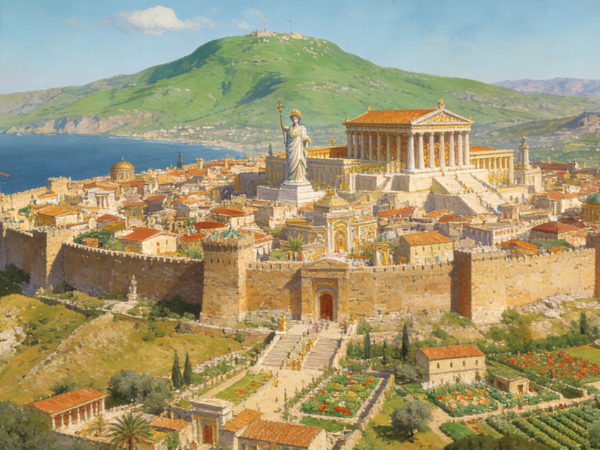
Troy was a very old city. For hundreds of years it had been growing in power and pride, and no man knew when or how the foundations of its greatness had been laid. “Ilium will stand forever,” said the boastful Trojans as they looked at its solid walls and its noble buildings. But, alas, sad changes at length took place, and cruel war destroyed many a proud hope.
From beyond the sea came hosts of Greeks, armed for war and determined to conquer the city. They came because one of the princes of Troy, Paris by name, had done a grievous wrong to Greece. He had stolen and carried away from her shores the most beautiful of her women, the wife of Menelaus of Sparta, by the name of Helen. Heroes and warriors from every city and town joined hands and vowed vengeance upon Troy. They came in a thousand little ships, and landed on the beach at the foot of the plain. They built huts and tents along the shore; they kindled fires; they built a wall of earth and stones around their camp; they challenged the warriors of Troy to come out on the plain and meet them in battle.
Thus the siege was begun, and for more than nine years the city was surrounded by determined foes; but the walls were strong, and the men who defended them were brave. Many fierce battles were fought outside of the gates. Sometimes the victory seemed to be with the Greeks, sometimes with the Trojans; but neither could gain any great advantage over the other. The Trojans could not drive the invaders from their shores; the Greeks could not force their way into the city. One hero after another was killed now on this side, now on that. Great were the losses of invaders and defenders, and great the suffering and grief; but still the struggle went on.
“Athene protects us,” said the hopeful people of Troy. “So long as the Palladium is with us, our city cannot be taken.”
The Palladium was a beautiful statue which stood in the temple of Athene. In it the Trojans placed their hopes, for they believed that it had the strange power of protecting its friends.
“It is useless for us to fight longer,” said one of the Greeks; “for we can never win while the Palladium is in Troy.”
“We have already stayed too long,” said others. “Let us give up this hopeless siege and return to our homes.”
But Ulysses, the wisest of all the heroes of Greece, was unwilling to give up. On a dark and stormy night he made his way by stealth into the city; he passed the guards unnoticed; he crept into the temple of Athene while all the watchers were asleep; he seized upon the Palladium and carried it to the camp by the shore. “Now we shall surely win,” said the Greeks; “for the Palladium is ours.” But still the Trojans held on and guarded well their gates; and still the weary siege went on.
II. The Great Horse
One morning in the early summer all Troy was awakened at daybreak by shouts from the sentinels on the walls. “What’s the matter now?” asked men, women, and children, as they hurried into the streets. “They are gone,” said one of the sentinels. “Who are gone?” “Why, the Greeks, of course.” “Oh, no! That is too good to be true.” “Then come up here and see for yourselves.” Soon a hundred eager men and women were standing on the wall, trying to make out in the grey light of dawn the hated tents by the beach and the black ships along the shore. “They are not there,” said the sharp-sighted sentinel. “No sign of Greek can be seen — no ship nor tent nor smoking camp fire. Thanks to Athene, they have left us at last.” “Look again,” said some of the doubtful ones. “Perhaps the fog hides them from your view.”
“There is no fog,” answered the sentinel. “But I see a strange dark object among the reeds, close by the inlet where the boys used to go swimming. I wonder what it can be.”
All looked toward the spot. Surely enough there was something among the reeds. It was smaller than a ship and larger than a man. In the dim light of the morning, it looked like a sea monster that had just come out from the waves.
“Perhaps it has swallowed the Greeks and their ships,” suggested a little man. “Ah, but what a fine large meal it must have had!”
Just then the sun rose above Mount Ida, shedding a rosy golden light upon sea and shore making every object on the beach clearly visible. There was no longer any doubt about the strange appearance in the reeds.
“It is a horse!” shouted one and all.
“But not a real horse,” said the sharp-sighted sentinel — “it is much too large. It is a huge, ill-shaped image, which the Greeks have left behind them, perhaps to frighten us. And now I remember that for several days there was something unusual going on behind the reeds and bushes — workmen hurrying back and forth and much noise of hammering and pounding. They were building this very image!”
Just then, Laocoon, a prince of Troy, joined the company on the wall. He was an old man, wrinkled and grey — a priest of Apollo, wiser and more discreet than most of his fellows.
Looking long and carefully at the strange image, he turned to the crowd around him and said, “It is a trick. My children, beware of the cunning Greeks. They have prepared this image to deceive you. I warn you to have nothing to do with it.”
Next excerpt: The Fall of Troy(2)
Next excerpt: The Fall of Troy(3)

One thought on “The Fall of Troy (1)”