It was noon time, when people in India prepared to eat their dinner. A grass-cutter, who had been busy since sunrise cutting grass for the cows of his master, was carrying on his head his load of grass bound together in a coarse rope net. Trudging along through a very thick part of the jungle, he was alarmed by a tiger! which suddenly crashed out of the bushes and glared at him. The great beast stood in the middle of the track, lashing his tail.
The grass-cutter turned to run away. He was a long way from his home and he knew that escape was almost hopeless, for the tiger, with his mighty power of springing, could catch him in one bound. So when the king of the jungle ceased lashing his tail and looked gently at the man as a sheep might look at her lamb, the grass-cutter saw that his only chance of safety was to listen when the tiger spoke.
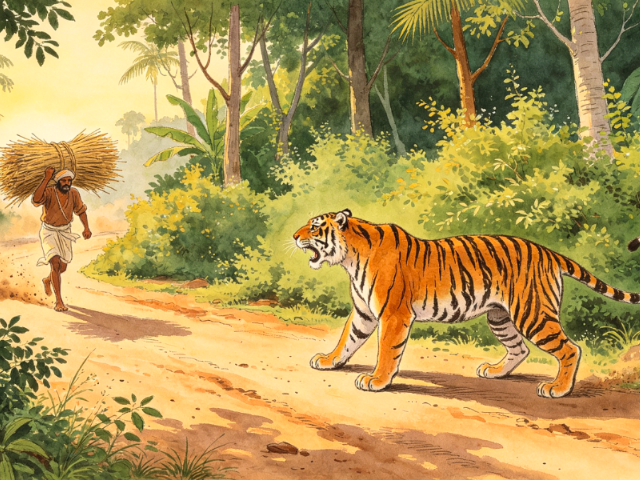
“Oh, grass-cutter, why are you frightened? Why would you run away?” asked the animal.
“Because you will kill and eat me,” replied the trembling man.
“Not so,” answered the tiger. “Stay, I command you! I have something important to say to you. Listen! I am an honourable tiger. If you will hide me in your load of grass, I will treat you as I would treat my father and my mother.”
To this strange request the grass-cutter was willing to agree; indeed, he felt in such danger of his life that he had no other choice. He had no weapon with which to defend himself except his reaping-hook and no man can fight a tiger with a reaping-hook.
“You are very big,” said the grass-cutter, “and you are very heavy. I am a poor and weak man. How can I lift you on my head?”
“There is only one thing for me to do then,” snarled the huge animal, looking fierce. “I must kill you and eat you. It is noon and I am hungry.”
“No no!” pleaded the grass-cutter in despair. “I have a wife and children to support. Spare my life, my lord.”
The man lowered his bundle of grass and untied the rope that bound it. At once the tiger crept in and curled himself in the middle of the grass as a cat might do. The grass-cutter covered him over and tied the rope very carefully so that not a bit of the creature’s body could be seen. With a great effort he managed to get the load on his head and, as he staggered on his way he was bent nearly double under the weight.
The man had not gone far when he met a huntsman with a gun. “Have you seen a tiger pass this way?” the huntsman asked.
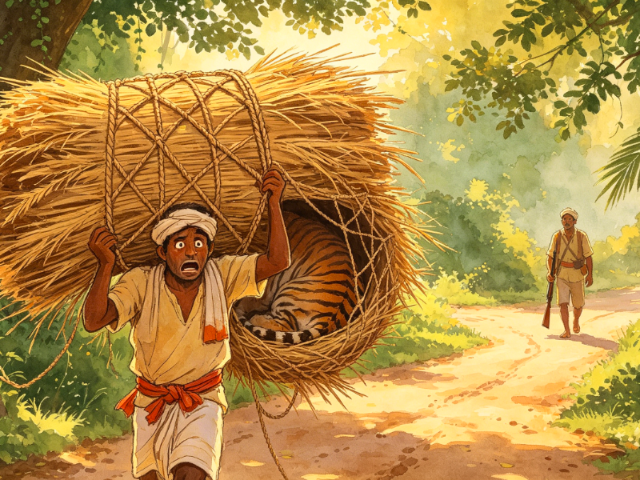
“No sir,” answered the grass-cutter. “I have seen no tiger.”
“He is a man-eater, a very dangerous animal,” said the huntsman. “He has killed several men, women and children, so I have come out to shoot him.” With these words he passed on his way.
No sooner had the huntsman gone than the tiger began to struggle to be free. “You have tied me too tight; let me out,” he growled. So the grass-cutter lifted the load from his head and placed it under a tree. When he had untied the rope, the tiger sprang out.
“You are a wicked man,” said the tiger. “You lied to the huntsman. Lies are always punished. As I am an honourable tiger, and never lie, I must punish you.”
“I lied to save your life,” cried the unhappy man. “The huntsman had come out to shoot you and I protected you.”
The tiger paid no heed to what the grass-cutter said. “You are a fine fat man. I shall kill you and eat you,” he snarled.
“But you promised to treat me as you would treat your father and your mother,” said the grass-cutter.
“I care not for promises,” answered the tiger. “That is the way of the jungle.”
“But it is not the way of the world,” replied the grass-cutter. “With us it is good for evil—”
“It is not so in the jungle,” snapped the tiger. “With us it is evil for good. Ask this tree.”
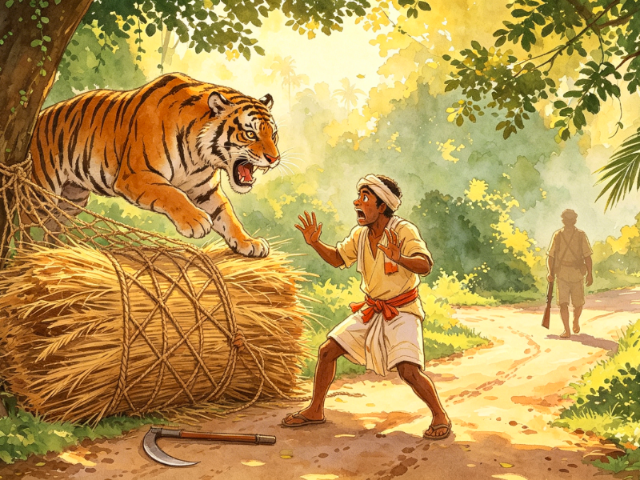
“Ah! Now that you have heard what the tree has said, you see that I am right,” growled the tiger. “I am an honourable tiger, and I must keep to the ways of the jungle folk.”
The grass-cutter was not going to give in, so he said calmly, “What can a tree know? His head is of wood. Let us first ask advice of yonder herd of buffaloes.”
The tiger agreed, so he and the man made their way towards the buffaloes. They spoke to an old cow buffalo who was grazing apart. She looked up and listened when they began their story, which told how the man had hidden the tiger in his load of grass, and how he had lied to save the tiger’s life, and how the tiger had promised to treat the grass-cutter as he would treat his own father and mother.
The old cow buffalo shook her head. “All those buffaloes you see grazing around me are my children and my grandchildren. They drank of my milk when they were young. I protected them. Now that they are strong and I am old and weak, they thrust their horns into my sides and push me away angrily; they will not even allow me to graze near them. The tiger is right; it is always evil for good.”
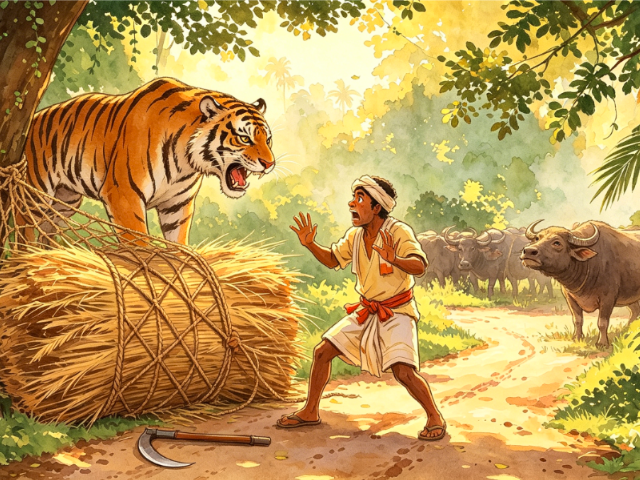
“Surely you see now that I speak the truth, my brother,” said the tiger. “Come, I am hungry.”
“Wait, wait!” cried the grass-cutter, who was now sorry that he had not left the tiger to the huntsman, who would have shot him. “Let us seek the advice of yet a third judge.” Again the tiger agreed, feeling certain that the advice would be the same.
At this moment a jackal peeped out of the jungle. “Oh, jackal!” they both cried. “Give judgment between us.”
The tiger explained the case. “On what you say depends my dinner and this man’s life,” he added.
When the jackal heard of the quarrel, he pretended to look very wise and, as is the manner of his tribe, he decided on a cunning trick.
“How can I believe this story?” he asked. He turned to the tiger and said, “Unless I see you hidden in the load of grass, so that I may be sure that you are speaking the truth, it is impossible for me to give judgment.”
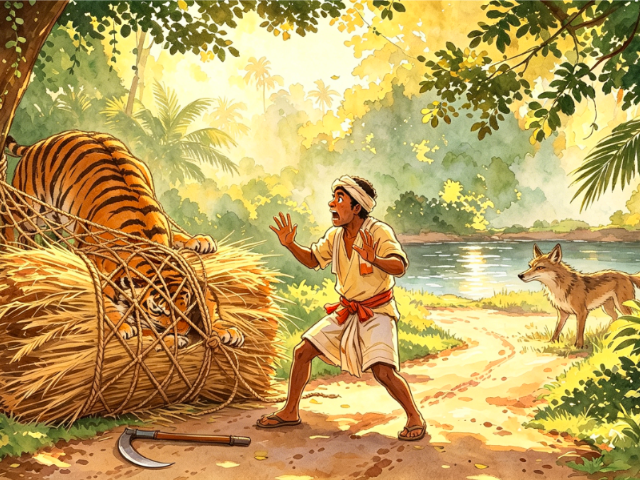
The tiger, who was hungry and anxious for his meal, ordered the grass-cutter to show the jackal exactly how he had been hidden. He told the grass-cutter to open the load of grass again and the tiger crept in as before and was tied up inside.
Then said the judge, “I see now that you have spoken the truth. And as evil for good is the way of the jungle, I command this man to throw you into the deepest part of the river so that you may be drowned.”
This the grass-cutter did joyfully and that was the end of the honourable tiger.