There was once a young street fiddler named Nicholas. Though a good musician, he earned only the slimmest living, indeed, so poor he was that he could not even afford to keep a cat.
One night, when he was in bed, he heard a tapping at his door. “Now, who can that be?” he asked himself. “Stock, the merchant, or Groschen, the banker, begging me to write a serenade for one of their grand affairs? Better yet, the King himself inviting me to play at court? Well, if it’s good news, it will keep; if bad, it can wait.”
So he pulled the quilt over his head; but the tapping went on until at last he had to get up and unlatch the door. There on the threshold he saw a black cat with white paws and a white star on his forehead.
“You’re worse off than I am if you haven’t a bed to sleep in or a roof over your head,” said Nicholas. “Come in, friend, for it’s a cool night to be roaming the streets.”
The cat graciously thanked him and at the fiddler’s invitation sat down on a stool. Nicholas had been saving a cup of milk and a heel of bread for his meal next day. Nevertheless, he offered it to the cat, who replied: “It’s rare enough, Master Nicholas, to find someone who’d give up his food to a human stranger, let alone to a cat. But no thank you, I’m not hungry.”
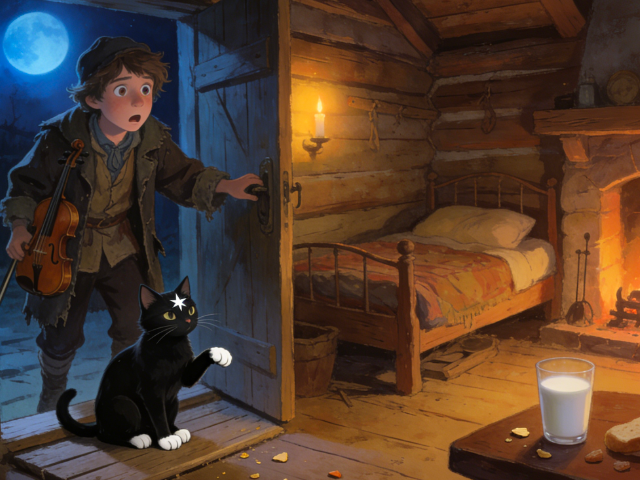
“Lucky cat,” said Nicholas. “Curl up at the fireplace, then. I’m sorry there’s no fire in it, even so, you’re welcome to stay.”
Again, the cat refused, saying: “That’s very kind of you, but the favor I came to ask is something other. Tonight, we cats hold our weekly ball. Our fiddler has gone traveling and we urgently need someone to play for us. Will you oblige?”
“That’s the best offer I’ve had all week,” said Nicholas. “In fact the only one. You cats must have better ears for music than most of the townsfolk. Yes, I’ll do it gladly.”
When the cat asked what his fee would be, Nicholas only laughed and said: “If it were Merchant Stock or Banker Groschen, I’d know how to set a price. But — fiddling for cats? Let it be a gift. My pleasure will be fee enough.”
“In that case,” the cat said, “follow me.”
Nicholas put on his clothes, took up his fiddle and bow, and went outside with the cat. In the street, he saw waiting a splendid coach drawn by a fine pair of white horses. The coachman was a striped cat in gold livery. The postilion, another cat also handsomely garbed, sprang down to open the door.
“I must say,” Nicholas remarked, settling himself beside his companion, “when you cats do something, you do it in style.”
“Naturally,” said the cat. “What did you expect?”
The coach set off briskly and Nicholas leaned back to enjoy the unforeseen luxury. As the curtains were closely buckled, he could see nothing beyond them and had no idea in the world where he was being taken. The cat, meanwhile, had opened a leather case from which he took an excellently tailored jacket, a pair of kidskin gloves, and gleaming black boots. These he pulled on, as well as a silken sash, and set a plumed hat on his head.
“We cats are usually content to go about our business in everyday fur,” he said. “On special occasions, however, it pleases us to show a little more flair. As Master of Revels, I feel I should set a certain tone.”
The coach halted, its passengers descended, and Nicholas found himself in a part of town he could not recognize. So, he had to follow the cat, who led him down a flight of stone steps to an oaken door. There, his guide knocked softly in a special way. A slate-gray cat, wearing a silver chain, opened at the signal, bowed deeply, and gestured for the new arrivals to enter.
Inside, Nicholas was so bedazzled that first he could hardly see. Candles blazed in glittering crystal chandeliers. The polished floor shone like a mirror. The ballroom was hung with draperies of crimson velvet. Everywhere he looked were cats, more than he could count, all in their finery.
After a few moments, he recognized the fishmonger’s cat, the hatter’s cat, the corn merchant’s piebald, and the cabinetmaker’s tortoise-shell, all of whom greeted him with utmost cordiality. And, in fact, when the Master of Revels announced that Nicholas had consented to fiddle for them, the whole company cheered.
This put him in such high spirits that he tucked his instrument under his chin and fiddled merrily away. He fiddled out polkas, waltzes, and minuets, and the delighted guests would have kept him playing without cease. Nicholas, enjoying the ball as much as the dancers, would gladly have done so. However, as the candles began guttering, the Master of Revels thanked Nicholas on behalf of the company.
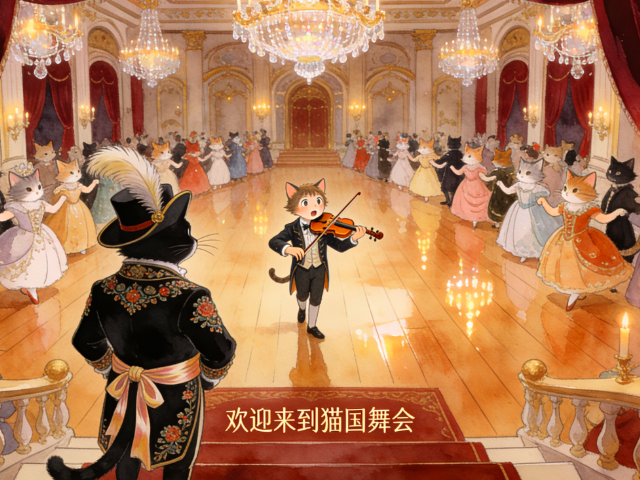
“We have enjoyed your excellent music,” said the cat, “and all urge me to make this request: Will you come back, a week from tomorrow night, and play for us again?”
“Indeed I will,” replied Nicholas. “You have my word.”
The cat then handed Nicholas a little packet and led him out to the waiting coach. This time he did not accompany the fiddler, but instructed the coachman to drive him swiftly home. Reminding Nicholas of his promise, he thanked him again and wished him a good night.
It was dawn by the time Nicholas was back in his bedchamber. He would have thought he had dreamed all the night’s happenings, had it not been for the packet in his hand. This he now untied and found in it four new fiddle strings, the finest he had seen, for they appeared to be spun from threads of gold.
Delighted, he immediately strung them in place of his old ones, which he had altogether worn out during his night of fiddling. When he played on them to test them, he grew all the more delighted. They were true-tempered, in every way perfect, with a clear and beautiful tone.
That day, as usual, he went out into the town and chose what he hoped would be a likely street corner. There he struck up a lively tune to draw the passers.
He had scarcely begun when Merchant Stock came by. Customarily, this grand personage turned a deaf ear to the fiddler’s music and had never thrown so much as a penny into the fiddler’s cap. But this time the merchant halted in front of Nicholas and declared: “Fiddler, I require your services. You will compose a serenade for my garden party. It must be the best quality. You yourself will play it. And, mind you, no skipping on the notes. I want plenty of them for my money.”
And Merchant Stock named a handsome fee, more than Nicholas could hope to earn in half a year.
“Gladly!” cried Nicholas. “You’ll have the finest serenade in the world!”
“Have it ready without fail,” warned Stock, “and come to my house a week from tonight.”
“A week from tonight?” returned Nicholas, dismayed. “Sir, that’s not possible. I have another engagement exactly then.”
“Alas, alas,” cried Nicholas. “I’ve already promised myself elsewhere. But if you could only give your party a night later or sooner, or any other time whatever —”
“Out of the question,” snapped the merchant. “My plans are set. All the town gentry have accepted my invitation. You could not possibly have an engagement more important than my garden party.”
“Sir, I’ve given my word,” replied Nicholas. “I’m to play for the cats’ ball.”
“What?” shouted Stock. “Are you serious? You prefer cats to me and my guests? How dare you! You’ll never again have business from me!”
Fuming, the merchant stamped off, leaving Nicholas to regret losing such a fat fee. However, Nicholas finally shrugged and told himself: Since he never had it to begin with, he could hardly miss it. In addition to keeping his word, he decided that indeed he would rather play for the town cats than for Merchant Stock. So, more than ever, he looked forward to the end of the week.
When that evening came, Nicholas impatiently waited in his chamber. No sooner had the town clock finished striking midnight than he heard a tapping at his door. It was the cat come to get him. As before, the coach carried him to the ball, where the company welcomed him with still greater warmth.
Nicholas played even better than the first time; and when the dancing ended, the elegant Master of Revels thanked him ceremoniously, adding: “Your music has given us the greatest pleasure. Will you come back, tomorrow night a week, and play for us again?”
“Gladly,” replied Nicholas. “So I promise you, and so I will.”
The cat then handed him a long, slender packet. Reminding Nicholas of their engagement, he thanked him once more and wished him a good night. At home, Nicholas untied the packet and found therein the handsomest fiddlestick he had ever seen — so lithe and light that when he drew it across the strings it seemed he was playing with a sunbeam.
That day on the street corner, Nicholas fiddled away so happily that he was at first unaware of Banker Groschen, who was shouting into his ear: “Leave off! I have important business in hand. Two Court Councillors, a Minister of State, and every high official in the town will attend my next banquet. I hire you to provide music for their entertainment.” And he named a sum even larger than the merchant’s.
Nicholas heard this with delight, but his face fell as the banker went on.
“Come to my house a week from tonight. Fail me in this, and I’ll never deal with you again.”
“Dear sir, any time but then!” cried Nicholas. “That very night I’ve given my word to play at the cats’ ball.”
At this, Groschen’s face went crimson and he burst out: “What nonsense is that? Unheard of! Do you put lowly cats ahead of my banquet guests?”
Groschen’s furious scolding had drawn a crowd of onlookers, and the banker now turned to them and said, “Did you hear this idiot? He tells me he’d rather fiddle for cats than councillors!”
The onlookers began hooting and laughing at the protesting Nicholas. Still raging, Banker Groschen strode away, leaving Nicholas bemused at himself for having turned down two fortunes in as many weeks.
Nevertheless, his new strings and his new fiddlestick cheered him. At the end of the week, when the coach arrived, he was in the best of spirits. He played for the dancing cats with such liveliness and grace that the Master of Revels could hardly express his gratitude.
“Surely, you won’t refuse to join us next week,” said the cat. “Meet us here again, give us your word on it.”
“That I will,” declared Nicholas, “and never fail.”
Home again, he untied the package the cat had given him as usual on his departure. Inside was the most beautiful fiddle he had ever seen. Instantly he set about playing it, and found its voice as magnificent as its appearance. So joyful he was that he kicked up his heels and went laughing and dancing around his chamber. In the morning, without having bothered sleeping, he skipped through town to his corner. He was so entranced by the cat’s gift he did not notice a splendid carriage halt in front of him.
“You there!” called the occupant. “Come here at once. I must have words with you.”
When Nicholas saw who addressed him, his bow slipped and his jaw slackened; for it was the Lord Chamberlain of the Realm.
“Stop gaping and listen to me carefully,” the dignitary ordered. “His Majesty commands you to play at court. You will, I assure you, be more than generously rewarded.”
Nicholas could hardly believe his ears. But what he thought was good fortune soured into disaster when the Lord Chamberlain named the very day Nicholas had promised the cats. When the despairing Nicholas explained his predicament and begged to be summoned any other time, the official gave him an icy stare. He said: “His Majesty will hear no excuse, least of all concerning cats. Furthermore, you have no choice. This is a Royal Command. Dare to refuse and you shall be punished for insubordination, low treason, and high treason.”
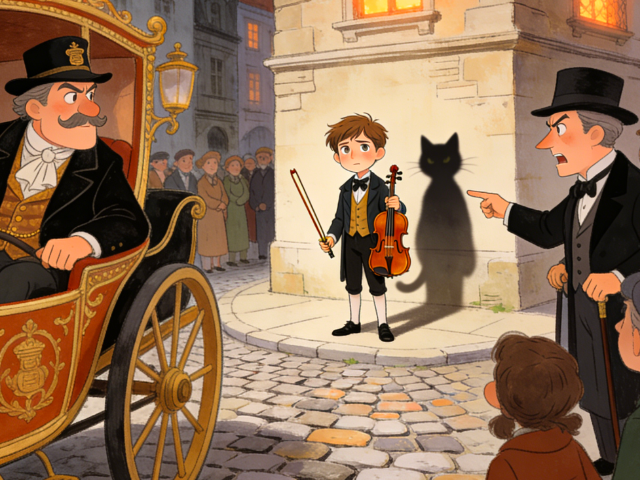
The Lord Chamberlain drove off without another word — leaving Nicholas pleading, quaking in his boots, and clearly seeing himself thrown into the royal dungeons.
For the rest of the week, the poor fellow expected a regiment of the King’s Grenadiers to arrive one moment to the next and haul him away. Nevertheless, he had given his promise and could only keep it. On the day of the cat’s ball, he left his corner earlier than usual and bolted himself into his chamber.
Well before midnight, he heard a tapping at his door. Thinking it must be the cat arriving ahead of time, he hurried to draw the bolt. But, instead of the Master of Revels, it was none other than the King himself.
“Your Majesty!” stammered the terrified Nicholas. “Has Your Majesty come in person to chop off my head? Sire, believe me, I meant you no offense.”
“I have no intention of chopping off your head,” replied the King. “You must understand that I commanded you to play at court not for my entertainment, but for my daughter’s. We have fiddlers by the dozens and, as far as I am concerned, one is as bad as the next. However, the Princess desires to hear you and no other. So, as a father, not a king, I am here to entreat you to go with me to the palace. I am told you have a previous appointment. But oblige me in this and you will have time to keep your other engagement.”
As the King was willing to accommodate himself to the fiddler’s situation, Nicholas could do no less than accommodate himself to the King’s. So he agreed, and the King conducted him to the royal coach waiting at the door.
“The Princess, alas, is much given to whims and fancies,” the King said, as they set out for the palace. “And now she has taken this latest notion, and Baron Sternbraue encourages her in it. The Baron has more influence with her than I, or the whole court, for that matter.”
“She does nothing without consulting him,” the King went on gloomily. “Now it is time for her to marry, but she will only choose a husband with his approval. He has turned down the most eligible noblemen in the land. So I fear His Excellency is altogether too particular.”
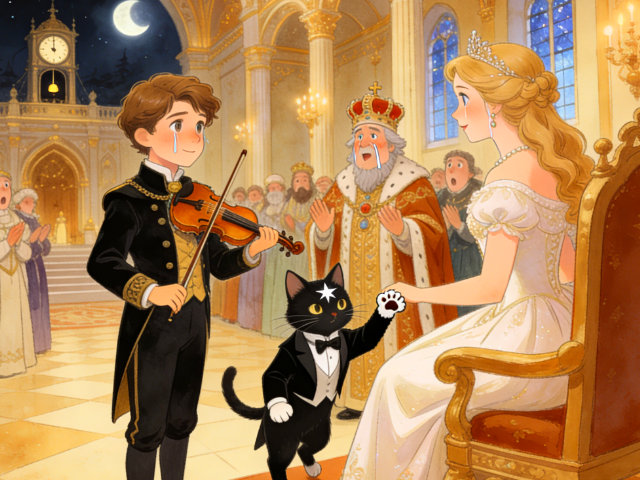
On arriving at the palace, Nicholas was led to the great hall, where the Princess sat on her throne. He had never seen any mortal or cat so beautiful. But what filled him with dread was the sight of her companion, Baron Sternbraue — a tall, severe, gray-haired man in formal black.
Nicholas’s heart fluttered, his head spinning, his knees quaking. His fingers trembled so violently they fumbled up and down the strings, his bow scraped and skittered, and, indeed, he nearly dropped his fiddle to the floor. The King rolled his eyes in dismay, and the courtiers snickered and looked askance at one another. But the Princess, gazing straight ahead at the despairing Nicholas, declared: “You are the one I choose to wed.”
“Dearest Princess!” cried Nicholas, as jubilant now as he had been distressed before. “I played badly when I meant to play my best. Even so, how glad I am that my fiddling has won your heart!”
“Most certainly it has not,” the Princess frankly replied, fondly smiling nevertheless. “I’ve never in all my life heard such abominable scraping and scratching. Yes, you have won my heart. But you did so even before you set bow to strings. However, I will not marry —”
“Daughter, what are you saying?” broke in the King. “First you’ll wed, then you won’t? If you love each other, what’s a sour note or two? Let him take a few lessons, he’s bound to improve.”
The Princess raised her hand and went on: “I will not marry without the approval of Baron Sternbraue.”
Nicholas groaned to himself, shaking with fear at the prospect of being judged by the all-powerful nobleman. He waited, breathless, as the Princess called for the Baron to come forward and give his opinion.
From behind her chair stepped a black cat with white paws and a white star on his forehead.
“You? Is it you?” stammered Nicholas. “You, the Master of Revels? And you, Baron Sternbraue?”
“One and the same,” replied the cat. “Generally speaking, we cats put no store in rank or titles. However, since it amuses the Princess to call me thus, in this case I don’t object to it.”
The cat then turned and said to the Princess: “This young man offered me shelter and his last morsel of food without even knowing who I was. He kept his word, though keeping it might have cost him his head. He has shown himself kindhearted, steadfast, and true — which is more than can be said of your noble suitors. Your Grace, you have my full approval.”
The courtiers applauded, and the King shed tears of joy, but just then the clock began striking midnight.
“Fiddler,” said the cat, “I believe you have an engagement elsewhere.”
Nicholas clapped a hand to his head. “So I do. Princess, excuse me. You understand —”
“Never fret,” put in the cat. “Tonight the Princess shall go with you.”
Leaving King and courtiers to celebrate without them, Nicholas and the Princess followed the cat to the palace gate. From there, the waiting coach sped them to the ball. When Baron Sternbraue announced the joyful news, the company cheered the loving pair to the echo. Since the cats’ own fiddler had returned from his travels, it was he who now played for the guests, while Nicholas and the Princess danced together until dawn.
And so they were married. Though Nicholas would have been proud to be known simply as the dear husband of the Princess, the King named him First Fiddler of the Realm. Despite this imposing title, whenever he was invited to play at the cats’ ball, Nicholas was delighted to accept.
And, since the Princess and Nicholas followed their cat’s advice in all important matters, of course they lived happily ever after.