Long ago in Japan, a village stood beside the sea. When the water was calm, the village children played in the gentle waves, shouting and laughing. But sometimes the sea was angry, and waves came tearing up the beach to the very edge of the town. Then everyone — children, fathers, and mothers — ran from the shore back to their homes. They shut their doors and waited for the storm to pass and for the sea to grow calm again.
Behind the village, there rose a mountain with a zigzag road that climbed up through the rice fields. These rice fields were all the wealth of the people. They worked hard in them all year round.
High on the side of the mountain, overlooking the village and the sea, there lived a wise old man called Ojiisan. His name in Japanese means “grandfather.” With him lived his little grandson, whose name was Tada.
Tada loved Ojiisan dearly and gave him all the honor due to his great age and great wisdom. Indeed, the old man had the respect of all the village people, who often asked him for advice.
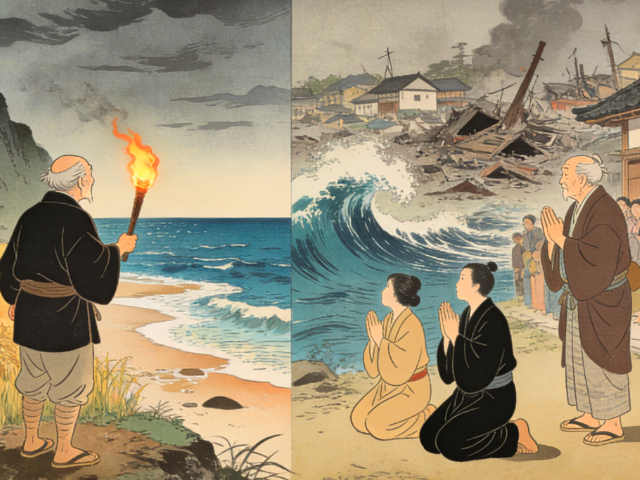
One day, when the air was very hot and still, Ojiisan stood on the porch of his house. At the foot of the mountain, he saw the village — ninety houses and a temple — stretched along the curve of the bay. There had been a very fine rice crop this year. The village people were going to celebrate their harvest with a dance in the court of the temple.
Tada came to stand beside his grandfather. He, too, looked down the mountain. They could see strings of paper lanterns tied between bamboo poles. Above the roofs of the houses, brightly-colored flags drooped in the heavy, warm air.
“This is earthquake weather,” said Ojiisan.
And soon an earthquake came. It was not strong enough to frighten Tada, for Japan has many earthquakes. But this one was strange — a long, slow shaking. It was as though it were caused by changes far out at the bottom of the sea. The house rocked gently several times. Then all became still again.
As the shaking stopped, Ojiisan’s keen eyes looked at the seashore. The water had grown dark quite suddenly. It was drawing back from the village. The thin curve of shore was growing wider and wider as the sea pulled back from the land.
Ojiisan and Tada saw the tiny figures of the village people gathering on the beach. As the water drew back, the sand and rocks were left bare. None of the village people seemed to know what it meant.
But Ojiisan knew. He understood what the sea was going to do. He must warn the village people.
There was no time to send a message down the long mountain road. There was no time to tell the temple monks to sound their big bell. There was no time to stand and think. Ojiisan must act. He said to Tada, “Quick! Light me a torch!”
Tada obeyed at once. He ran into the house and lit a pine torch. Quickly, he gave it to Ojiisan.
The old man hurried out to the fields, where his rice stood ready for the harvest. This was his precious rice, all his work for the past year, all his food for the year to come.
He put the torch to the dry rice, and the fire blazed upward. Sparks burst into flame. The flames raced through Ojiisan’s fields, turning their gold to black and sending up columns of whirling smoke.
Tada was amazed and terrified. He ran after his grandfather, crying, “Ojiisan! Why? Ojiisan! Why? Why?”
But Ojiisan did not answer. He had no time to explain. He was thinking only of the four hundred lives in danger by the edge of the sea.
For a moment, Tada stared wildly at the blazing rice. Then he burst into tears and ran back to the house. He felt sure that his grandfather had lost his mind.
Ojiisan went on firing the rice till he had reached the end of his fields. Then he threw down his torch and waited.
Down below, the monks in the temple saw the blaze on the mountain and set the big bell booming. The people hurried over the beach and up from the village, like a swarm of ants.
Ojiisan watched them from his burning rice fields. The moments seemed terribly long to him.
“Faster! Run faster!” he yelled. But the people could not hear him.
The sun was going down, and still the sea was fleeing away from the land.
Ojiisan did not have long to wait before the first of the village people arrived to put out the fire. But the old man held out both arms to stop them.
“Let it burn!” he commanded. “I want all the people here. There is a great danger!”
The whole village did come — first the young men and women. Then came the older folks and parents carrying babies. Even the children came, for they could help to pass buckets of water. But it was too late to save the flaming fields of Ojiisan. All looked in sorrowful wonder at the face of the old man.
Tada came running from the house. “Grandfather has lost his mind!” he sobbed. “He has gone mad! He has set fire to the rice on purpose. I saw him do it!”
“The child tells the truth. I did set fire to the rice,” said Ojiisan. “Are all the people here?”
The village leaders were angry. “All are here,” they said. They muttered among themselves. “The old man is mad. He will destroy our fields next!” Then Ojiisan raised his hand and pointed to the sea. “Look!” he said. The people looked and saw a long dim line, like the shadow of a coast, where no coast ever had been. The line grew wider and darker. It moved toward them. That long darkness was the returning sea, towering like a cliff and coming toward them as quickly as the hawk flies.
“A tidal wave!” screamed the people. And then all sounds and all power to hear sounds were ended by a shock heavier than any thunder. The great wave pounded the shore with such force that it sent a shudder through the hills. There was a burst of foam like a blaze of sheet lightning. Then, for an instant, nothing could be seen but a storm of spray. It rushed up the side of the mountain and sent the people scattering in fear.
When they looked again, they saw a wild white sea where their homes had been. It drew back, roaring and tearing out the land as it went. Five times the sea struck, but each time with less strength. Finally, it came no more, though it still churned angrily.
Around the house of Ojiisan, no one spoke a word. The people stared down the mountain at the ruins that had once been ninety houses and a temple. The village was no longer there.
Then the voice of Ojiisan was heard again, saying gently, “That was why I set fire to the rice.” He, their wise old friend, now stood among them almost as poor as the poorest. His wealth was gone, but he had saved four hundred lives.
Tada ran to him and held his hand. The head of each family knelt before Ojiisan, and all the people after them.
“My home still stands,” the old man said. “There is room for many.” And he led the way to the house.
When better times came, the people did not forget what they owed Ojiisan. They could never make him rich. But when they rebuilt the village, they built a temple to honor him.
It is said that his temple still stands and that they still honor the good farmer who saved his people from the great tidal wave by burning his rice fields.