An Arab prince had heard that in a certain town there was a judge who was very clever in discovering the truth. The prince wished to test the ability of the judge personally, and so he disguised himself as a merchant and set out for the town on his horse.
Near the town where the judge lived, a beggar came up to the prince and asked him for money. The prince gave him some money, but as he was about to continue on his way the beggar stopped him again.
“What more do you want of me?” asked the prince.
“Can’t you let me ride with you on your horse as far as the town?” asked the beggar. “It’s difficult for me to walk even though it is a short distance.”
The prince therefore let the beggar sit behind him on the horse and together they rode into the centre of the town.
“Here we are,” said the prince at last. “you can get off here.”
“Why should I get off the horse if the horse is mine?” said the beggar. “You get off or I will call the police.”
As the two men continued to argue, a crowd gathered, and finally someone suggested that they go to the judge and let him settle the case. They went before the judge but had to wait their turn. There were other cases ahead of them.
A well-educated man and an ignorant farmer were both claiming the same servant girl. After hearing them both, the judge said:
“Leave the girl here and come back tomorrow.”
The next case concerned a butcher and a man who sold oil. The butcher said:
“I went to this man’s store to buy some oil, and when I took out my money he tried to take it from me.”
“The man is lying,” said the man who sold oil. “He came to buy some oil and asked me to change a gold piece for him, and when I took out my money he tried to take it from me. I grabbed his hand, and together we have come to you to decide the case.”
“Leave the money here,” said the judge, “and come back tomorrow.”
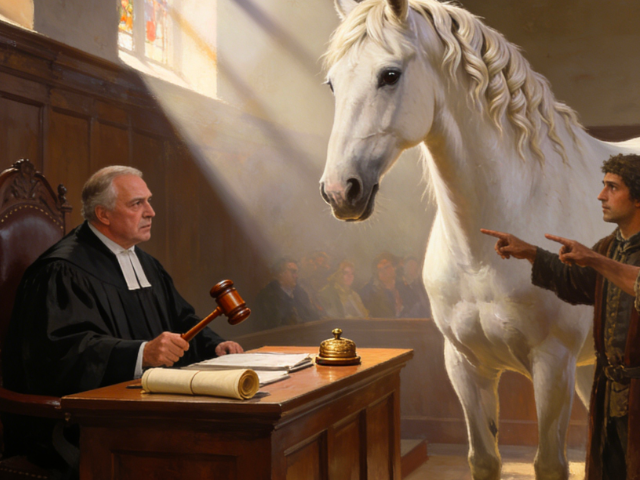
Next came the prince and the beggar. Each one told his story and each one said that the horse was his.
After hearing them both, the judge said:
“Leave the horse here and come back tomorrow.”
The next day many people came to hear the judge’s decisions. When the educated man and the ignorant farmer appeared, the judge said to the educated man: “The girl is yours. Take her with you. The farmer will be given fifty blows with a whip as a punishment.”
Next, he called the butcher.
“The money is yours. The seller of oil is a thief and will be punished.”
Next he asked both the prince and the beggar whether they could recognize their horse among many others. Both of them said that they could. The judge then took them, one at a time, to a stable where there were many horses, each of them recognized the horse without difficulty.
When they returned, however, the judge said to the prince:
“Take the horse. It is yours.”
The judge then ordered that the beggar be given fifty blows with a whip.
Later the prince went to see the judge.
“Aren’t you satisfied with the decision?” asked the judge.
“Certainly,” said the prince. “But I am Prince Baukas and I came here in order to test your ability because I had heard of you very often. But can you tell me how you decided each of these cases?”
“I called the servant girl of the educated man this morning,” said the judge very simply, “and told her to fill my ink bottle with ink. She took the inkbottle, cleaned it carefully, and then filled it with ink — all within a few minutes and very well. Clearly, such work was not new to her. If she had been the servant of the ignorant farmer, she would not have been able to do such work so expertly.”
“As concerns the money of the butcher, I placed the money in water and this morning. I looked to see whether there was any indication of oil on the water. If the money had belonged to the man who sells oil, the money would have shown marks of the oil with which, as I had noticed, his hands were covered.”
“The case of the horse was a little more difficult. I knew that both of you would be able to recognize the horse but I wanted to find out which one of you the horse would recognize. When you went to the stable, I saw that the horse turned his head to look at you. When the beggar approached the horse, the horse raised one foot and looked in the other direction indifferently. Thus I knew the horse belonged to you.”
The prince wished to pay the judge something.
“Nothing that you could give me would be worth the satisfaction of having decided the cases fairly.” said the judge. “I only hope that in the future God may always help me in my work to see equally well the path of truth.”