Once upon a time there lived a woodcutter and his wife. They had two children: a boy called Hansel and a girl whose name was Gretel.
The woodcutter and his family lived in a cottage on the outskirts of a forest. The man worked hard, but he could never cut down enough trees or chop up enough wood to earn more than a bare living.
Then a famine hit the land and things became worse than ever.
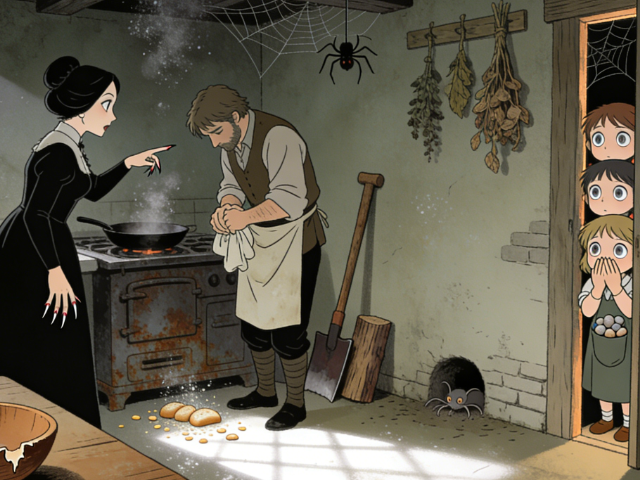
One night, the whole family went to bed hungry and the bad-tempered wife spoke angrily to her husband.
“There is enough food for you and me,” she said. “If we eat it the children will go hungry. If we give it to them we shall starve.”
“We must let the children have it,” declared the kind woodcutter. “It does not matter about us.”
But his wife did not agree with him.
“They will suffer less if we take them into the forest and leave them there,” she decided.
The woodcutter pleaded with her but she would not listen and at last he had to promise to carry out her wicked plan.
Now the cottage walls were thin and Hansel and Gretel had been able to hear all that their parents had said.
“Do not worry,” said the little boy to his weeping sister. “I will make sure that we can find our way home again.”
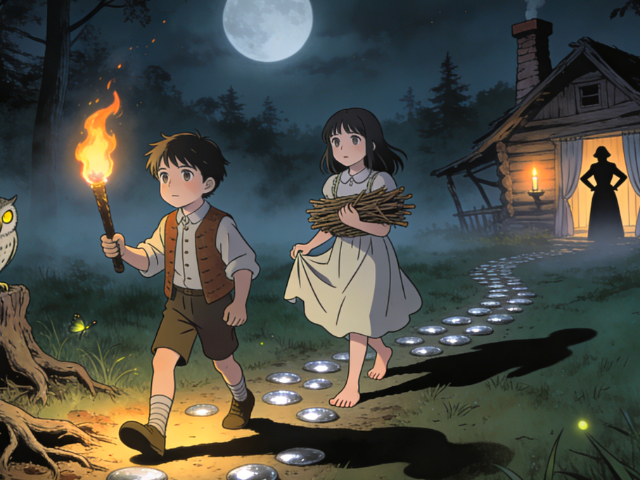
He opened the door and crept outside. He filled his pockets with the pebbles, which were glittering like silver on the ground in the moonlight.
The next day the children’s mother wakened them.
“Get up!” she cried. “We are all going to the forest to fetch wood.”
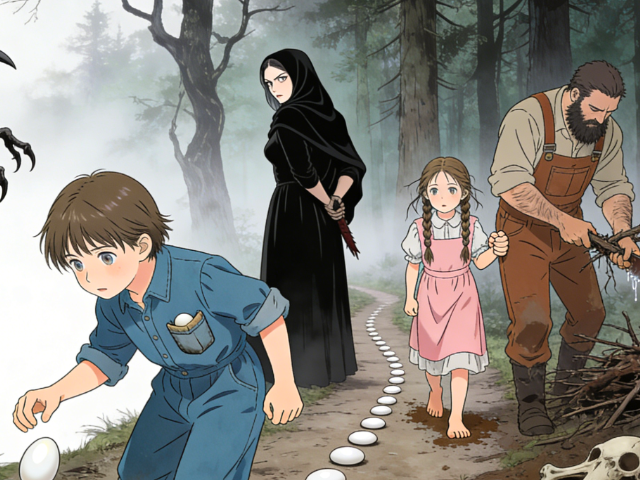
On the way Hansel kept stopping and looking round.
“Why do you look back, Hansel?” asked his father.
“I am watching my white kitten sitting on the roof,” replied Hansel.
But each time he stopped, Hansel threw down one of the white pebbles.
The woodcutter built a fire to keep the children warm and then he left them. They fell asleep and when they awoke it was quite dark. Poor Gretel began to cry.
“Do not worry,” said Hansel.
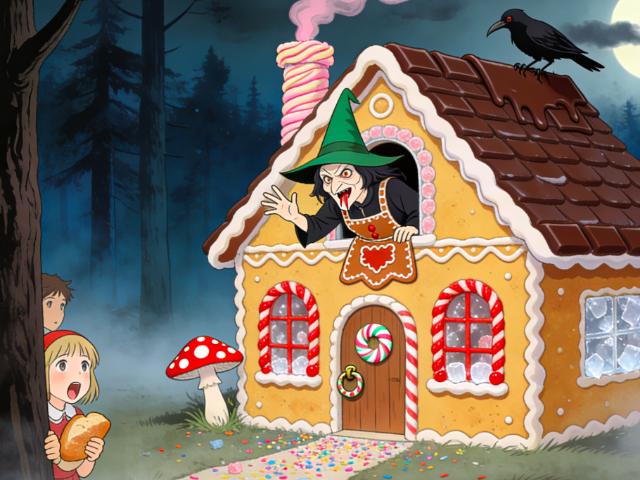
He took his sister to the path and the pebbles were gleaming so brightly in the moonlight that they led the children home. Their father was delighted to see them, but their mother scolded them, pretending that the children had lost themselves. When things grew no better the wicked mother decided to try the plan again and this time Hansel could not get out to gather any pebbles. On the way he stopped as he had done before, telling his father that he was watching his pigeon. But he was throwing down crumbs from the tiny pieces of bread they had been given. Once more Hansel and Gretel were left behind. When night came they looked for the breadcrumbs, but alas, the birds had eaten them! The children tried to find their way but every path looked the same and soon they were lost. A shining white bird sang such a sweet song that the two children followed it down a path they had not tried before. At the end of the winding path the two hungry children came upon a wonderful sight. They saw a dear little cottage, which was different from any other house in the world. It had walls of gingerbread and the roof was of cakes, while all the windows were of crystal clear sugar Hansel and Gretel began to eat pieces of the house when the door opened and the owner peered out. The person they saw was an ugly woman who looked like a witch. She spoke kindly to Hansel and Gretel and beckoned them inside her lovely sweetmeat house.
She gave them a wonderful meal and when they had finished it she showed them two little beds made up with warm blankets, and soft pillows. She was so kind that Hansel and Gretel could not believe that she would do them any harm, and so they climbed into the beds and fell asleep at once.
The old woman took the smile from her face and looked very horrible indeed as she rubbed her hands together greedily.
“They will make a dainty dish!” she whispered. “I will eat the boy first and then his sister!”
Poor Hansel and Gretel had fallen into a witch’s trap. They were to make her a very special meal!
Early the next morning, the old woman seized the sleeping Hansel in a bony hand, and thrust him into a big cage before she wakened Gretel.
“Get up, lazybones, and cook the breakfast for your brother,” she shouted. “You must feed him up until he is plump and tender enough for me to eat!”
Poor Gretel had to do what she was told. She cooked so much food for her brother that he soon grew plump.
Now the old witch could not see well and so she could not discover how fat Hansel was growing.
“Put out your finger, boy,” she cried. “I can tell from that whether you are ready for my dinner.”
Clever Hansel poked a bone through the bars of his cage. The old woman grasped it and frowned because what she thought was his finger was far too thin. The rest of him would not make a good meal for her.
Every day the witch went to the cage and felt the bone Hansel pushed out. Then she would leave him, muttering that he was far too thin.
Poor little Gretel cooked all the lovely meals the witch insisted Hansel must eat. All the witch would let her have were the scraps, and the old hag saw to it that Gretel did not have too many of those.
So as Hansel grew very plump indeed, Gretel became very thin.
The days went by, and the weeks, until a whole month had passed. Hansel sat in his cage, longing to get out and run about, but eating up all the good things poor Gretel had cooked for him.
The little girl worked hard in the cottage and she was the best servant the old woman had ever had. She cleaned the cottage until it was spick and span, mopping the floors and polishing the furniture.
She made gingerbread and cake to repair the walls and roof of the magic cottage. All the time she tried to think of a plan to help Hansel out of his cage so that they could both escape.
The old witch could not see well, but her ears were very sharp. She did not miss one word the brother and sister said to one another, and so it seemed as if they would have to stay there until they were eaten up.
At last the old woman grew tired of waiting for Hansel to grow plump enough.
“He will never get fat,” she cried. “I will not wait any longer for my tasty meal. Whether he is fat or thin I shall eat him tomorrow!”
Poor Gretel cried as she cleaned up the cottage. Then she went for the water the old woman wanted fetching, ready for the next day’s big feast.
When morning came the witch made Gretel stoke up the fire so that the oven was hot enough to cook poor Hansel.
“First we will bake,” said the old woman. “The oven must be very hot for that. Pile on more sticks, girl, while I make the dough and knead it.”
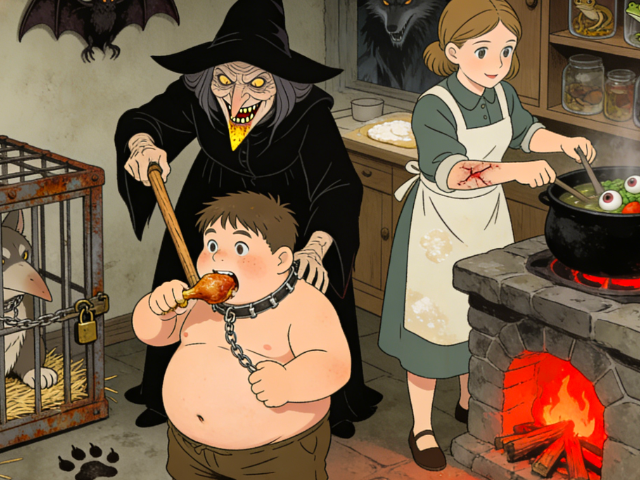
Gretel stoked up the fire until the flames shot out hungrily, while the old dame kneaded the dough into a big, round loaf.
“You must tell me if the oven is hot enough, child,” demanded the witch.
The wicked old woman had decided to push Gretel into the oven and eat her before she started cooking Hansel. Gretel went to the oven.
“How can I tell if the oven is hot enough?” she asked.
“Creep inside,” cackled the old witch. “Then you will know.” Gretel pretended not to understand.
“I do not know how to do it,” she said. “Please show me the way.”
“You are a silly goose!” cried the old witch. “The oven is quite big enough for you to climb in and see for yourself.”
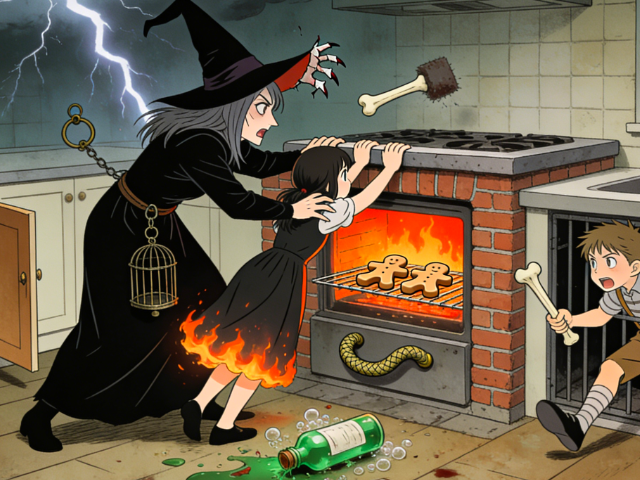
Gretel pretended to try.
“The oven is too small. I cannot get in,” she declared.
“The opening is quite big enough,” snarled the witch. “See, I could get in myself if I wanted to.”
She went to the oven and poked her head inside the door, which was just what Gretel was hoping she would do. The little girl gave the old woman a push and into the oven she went, which was the end of her.
Gretel rushed across to Hansel’s cage and opened the door so that he could escape. He jumped out and he and Gretel joined hands and danced round the witch’s kitchen, which looked a much better place without her.
Then Gretel made a meal, which this time she was able to enjoy with her brother.
“Now we must decide what to do,” said Hansel.
“We must go home, of course!” cried Gretel.
But Hansel remembered what had happened to them before.
“Let us stay in the cottage and look round first,” he said. “Perhaps the old witch had some treasure hidden away.”
The brother and sister went into each room in the house. In every corner they found bags of gold and precious stones which the old woman had stolen from the unfortunate people who had crossed her path.
Hansel packed his pockets with pearls, diamonds and rubies, while Gretel filled her apron. Then they picked up the bags of golden money and set off to find their way home once more.
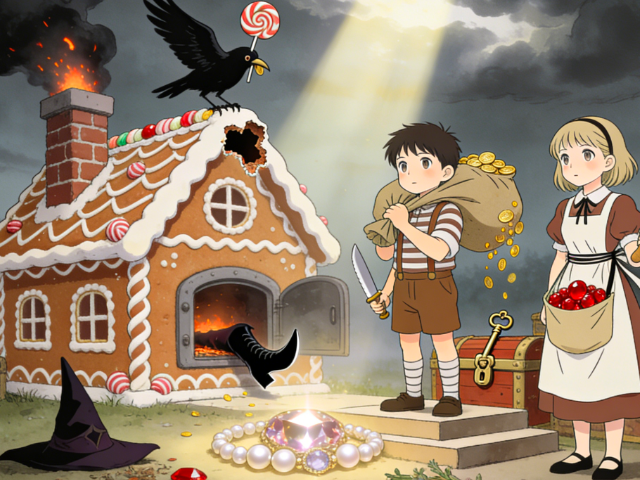
Hansel and Gretel hurried away from the witch’s part of the forest as fast as they could, but they were still as lost as they had been before. They found a new path and went along it. When they came to the end of it a huge lake lay spread before them.
“I wish we could cross over it,” said Gretel. “Then we would be at the other side of the wood and nearer to our home.”
“There is no bridge,” sighed Hansel. “And no sign of a ferry boat either.”
“I see a big white duck!” cried Gretel. “Perhaps she can help us to get across the water.”
The children called to the duck and she swam across to them.
“Climb on her back, Gretel,” cried Hansel. He began to scramble over the bird’s white wings, but stopped when Gretel said.
“You go first with the bags of gold, Hansel, then the kind duck will come back for me. Two of us will be too heavy for her.” So that is what they did.
The duck swam to the other side with Hansel and his bags of gold, then she came back for Gretel with her apronful of precious stones.
That part of the forest on the other side of the lake was much nearer to the children’s home and at last they found a path which led them to it. It looked just as it had done when they had left it, but inside the house things were not the same.
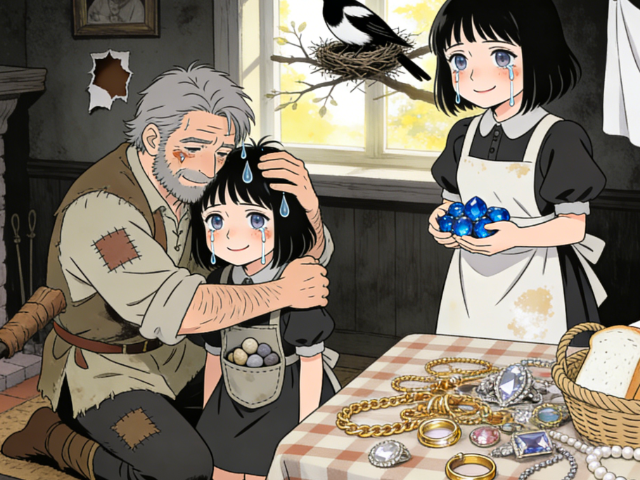
The wicked mother had died and their father was sitting alone. He was mourning his unkindness to his children, as he had done every day since they had gone.
Hansel and Gretel threw themselves into their father’s arms and he hugged and kissed them.
“I shall never send you away again,” he cried. “Some way we will manage, however poor we are.”
Then Hansel, with his father looking on in amazement, emptied the precious stones out of his pockets and Gretel spilled her apronful on to the table.
After that they gave their father the bags of gold and there is no doubt at all that they all lived together happily ever after.