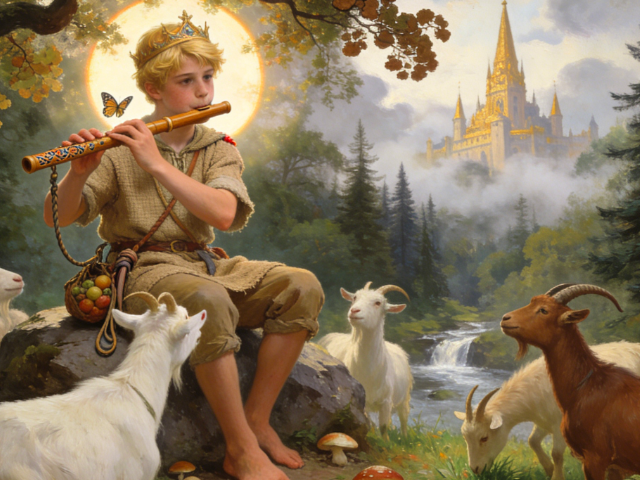
The young king was sitting alone in his beautiful room in the palace. He was only sixteen years old; he was wild-eyed like some animal of the forest. The servants of the old king had found him in the forest. He was sitting there playing his pipe and watching the forester’s goats. This poor forester had brought him up ever since he was a baby, and the boy believed that he was his son; but he was the child of the old king’s daughter.
The king’s daughter had married a common man, a man far below her. He was a painter, painting pictures on the walls of the great church in which kings were crowned. The princess showed him too much honour and suddenly he went away, leaving his pictures unfinished. When the baby was only a week old he was taken away from his mother’s side while she slept. The forester and his wife had no children, and lived more than a mile away in the forest. The baby was put in their hands.
The princess died.
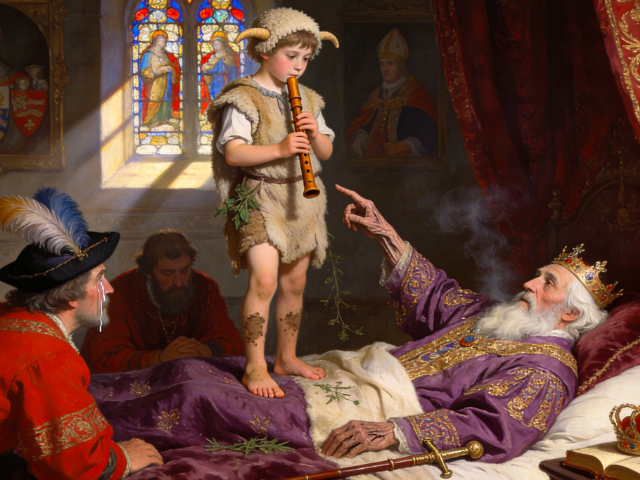
When the old king was dying he said, “My heart is heavy because of the great wrong which I have done. Do not let the crown pass away from my family. Send for my daughter’s child who is with the forester. He shall be king after me.”
When the boy was brought to the palace, he showed a strange love for all beautiful things. He gave a cry of pleasure when he saw the beautiful clothes and rich jewels which had been prepared for him. With joy he threw aside the old coat which he had worn in the forest. Whenever he could escape from the long meetings with the great lords and captains, he wandered from room to room through the palace finding beauty everywhere.
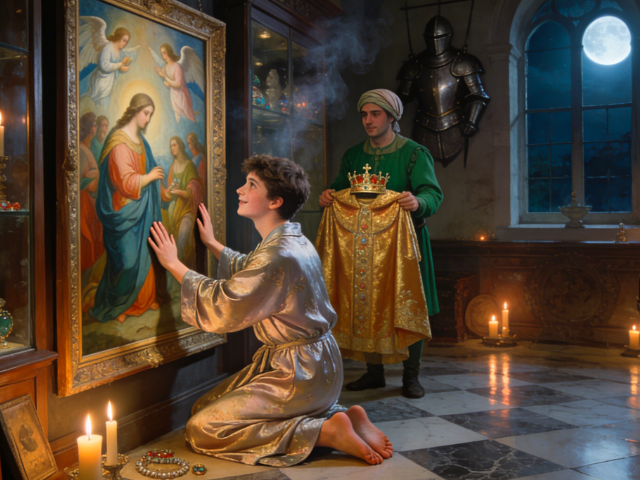
A rich merchant who had come to see the king found him kneeling in front of a beautiful picture which had just been brought from Venice. On another day, after people had searched for several hours, they found him in a little room at the north end of the palace looking with wonder at the shape of the Greek god Adonis cut in a jewel.
As he lay in his bed he was thinking of the wonderful coat of gold thread which he would wear when he was crowned, and of his jewelled crown and sceptre. The best artists in the world had planned them, and the workers were ordered to work day and night to finish them. He could see himself standing in the great church dressed as a king, wearing these wonderful things.
His eyes closed, and sleep came over him; and as he slept, he dreamed.
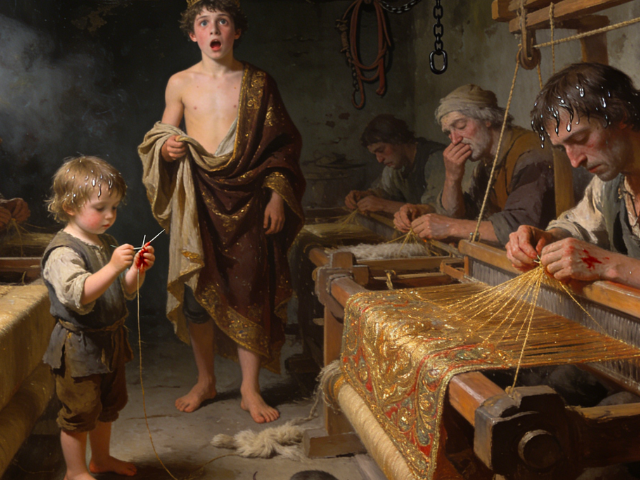
He dreamed that he was standing in a long, low room. All round him he heard the noise of weavers at their work of making cloth. Only a little daylight came in through narrow barred windows. Their faces were white and thin. Little children were working with them; they were weak from hunger and their little hands shook.
The young king went to one of the weavers and stood by him and watched. The weaver looked at him angrily.
“Why are you watching me?” he said. “Were you sent by our master to keep watch on us?”
“Who is your master?” asked the young king.
“Our master is a man like myself. There are only two differences between us: he wears fine clothes; and, while I am weak from hunger, he suffers from having too much food.”
“The land is free,” said the young king, “and you are no man’s slave: you are not an unpaid worker owned by a master.”
“In war,” answered the weaver, “the strong make slaves of the weak, and in peace the rich make slaves of the poor. We must work to live, but they pay us so little that we die. We grow the corn, but we have no bread. We are slaves, though all men call us free. But what do these things matter to you? You are not one of us: your face is too happy.”
He turned away and went on weaving, and the young king saw that the thread was of gold and the cloth was cloth of gold. Cold fear seized his heart.
“Who are you weaving that for?” he asked.
“I am weaving it for the crowning of the young king. But what does that matter to you?”
The young king gave a loud cry and woke. He was in his own room in the palace, and through the window he saw the golden moon hanging in the sky.
He fell asleep again and dreamed. He dreamed that he was on a ship which was being rowed by hundreds of slaves. The master of the ship was sitting in front. His coat was of red silk and great silver rings pulled down his ears. The slaves had only a cloth round their middle. Each man was chained to the man next to him. The hot sun beat down upon them and a man ran up and down between them and struck them so that the blood came, to make them row faster.
At last they came to a little bay. They stopped. The seamen seized one of the youngest slaves. They took off his chains. They tied a stone to his feet and let him down by a rope over the side of the ship. After some time he was pulled up out of the water: he had a pearl in his right hand. The seamen took it from him, then pushed him back into the water.
The young slave came up again and again; each time he brought with him a beautiful pearl. The master of the ship put the pearls in a green bag.
Then the slave came up for the last time. The pearl that he brought was the best of all. It was shaped like the full moon and brighter than the morning star. But the face of the slave was strangely white, as he fell down; blood came from his ears and mouth.
“Dead?” said the master. “Throw the body into the sea.” He looked at the pearl: “This shall be for the sceptre of the young king.”
When the young king heard this, he gave a great cry and woke. Through the window he saw the stars beginning to grow dim and the daylight coming.
He fell asleep again and dreamed.
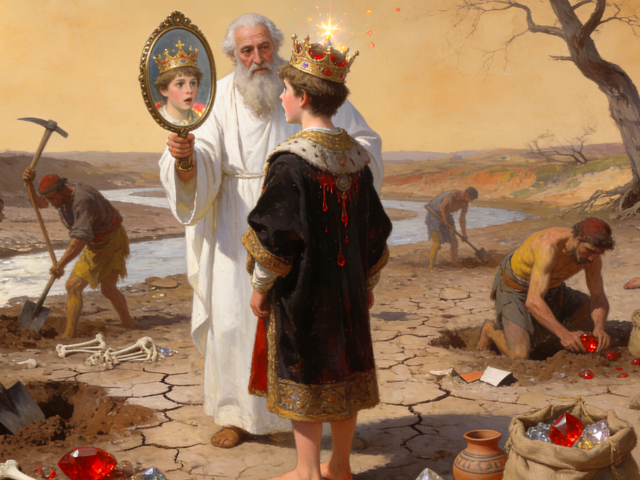
He dreamed that he was wandering through a dark forest full of strange fruit and beautiful flowers. He went on and on until he came out of the forest and there he saw a great crowd of men working in a dried-up river. They dug great holes in the ground and broke the rocks with axes. They hurried about calling to each other.
He turned and saw an old man standing behind him, holding a mirror in his hand. “Who are these men?” he asked. “The people in the walled cities have no food, and the wells in the country are dry,” said the old man. “But these men are working in the dried-up river to find …” “What are they trying to find?” “Jewels—for a king’s crown,” said the old man. “For what king?” “Look in the glass and you will see him.” He looked in the glass and saw his own face. He gave a great cry and woke. Bright sunlight was shining into the room and birds were singing in the trees of the garden. The lords and high officers of the government came into the young king’s room and bowed to him. The servants brought the coat made of cloth of gold and set down the crown and sceptre before him. The young king looked at the things and saw that they were beautiful, more beautiful than anything he had ever seen. But he remembered his dreams, and he said, “Take these things away. I will not wear them.” The lords and high officers of the government were very surprised. Some of them thought that he had said this in fun, and they laughed. He spoke to them again: “Take these things away and hide them from me. I will not wear them. This cloth was woven by the white hands of pain. There is blood in jewels and death in the heart of the pearl.” And he told them his three dreams. When the lords and officers heard this they said, “He does not know what he is saying: he is out of his mind, for a dream is only a dream. Dreams are not real things and one should take no notice of them. What do the lives of those who work for us matter? Must a man not eat until he has seen the man who grew the corn?
How are the people to know that you are king if you are not dressed as a king?” The young king looked at them. “Is that so?” he asked. “Will they not know me as king if I have not the clothing of a king?” “They will not know you,” said the chief officer. “I had thought,” he answered, “that there were men who looked like kings. Perhaps you are right. But I will not wear this coat and I will not be crowned with this crown. I will go out from the palace just as I came into it. Go, all of you. Let only this boy-servant remain.” He opened a big box and took out of it the rough coat which he wore when he was watching goats on the hillside; in his hand he took the stick which he carried as a goat-herd. The boy-servant said, “Sir, I see your coat and your sceptre, but where is your crown?” The young king took a branch of a wild-rose which had grown up near the window. He made it into a circle and put it on his head. “This shall be my crown,” he said, and he went out of his room into the Great Hall, where the lords and high officers were waiting for him. He went down into the courtyard. He got up on his horse and rode out through the great gates of the palace to go to the church to be crowned; and the boy ran beside him. The people in the streets laughed. “It is the king’s fool who is riding by,” they said. He stopped and answered, “No: I am the king” — and he told them his three dreams. A man came out of the crowd and spoke angrily to him: “The life of the poor comes from the fine things that the rich use. The making of these things gives us bread. Go back to your palace and put on the clothing of a king. Why should you care for us and what we suffer?” “Are not the rich and the poor brothers?” asked the young king. His eyes filled with tears and he rode on through the angry cries of the people. The boy-servant became afraid and left him.
The soldiers tried to stop him at the great gate of the church:
“No one may enter here except the king.”
“I am the king,” he answered angrily, and he pushed them aside.
The highest priest in the church was waiting to crown the new king. The High Priest saw the young king coming dressed as a goat-herd. He went to meet him and said, “My son, is this the dress of a king? With what crown shall I crown you? what sceptre shall I put in your hand? This should be a day of joy.”
“Shall joy wear what sadness and pain have made?” said the king; and he told him his dreams.
“I am an old man,” answered the High Priest, “and I know that many wrong things are done in the world; but God has made us as we are, and He is wiser than you. The weight of this world’s suffering is too great for one man to bear, too heavy for one man to suffer.”
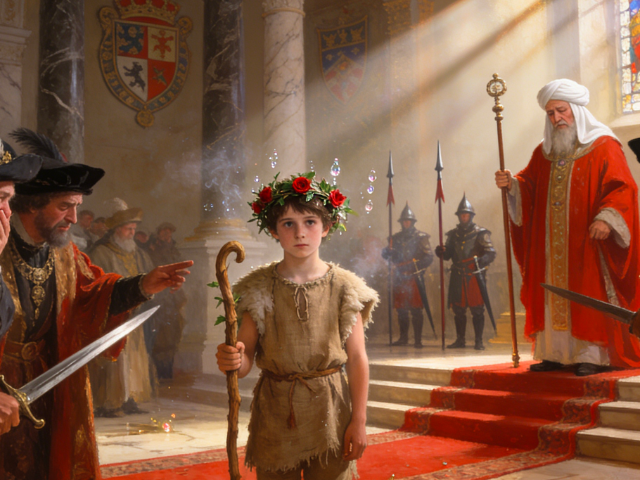
“Do you say that in this house of God!” said the young king. He walked past the High Priest and knelt and bowed his head in prayer.
Suddenly a great noise came from the street outside. The lords entered, shouting, “Where is this dreamer of dreams? Where is the king who is dressed as a goat-herd? He is not fit to rule over us!”
The young king stood up. He turned and looked at them sadly.
Then sunlight poured down through the coloured glass of the window and made for him a covering far more beautiful than the coat of cloth of gold. The stick put out white flowers more beautiful than any pearl, and the wild rose on his head shone brighter than any jewel.
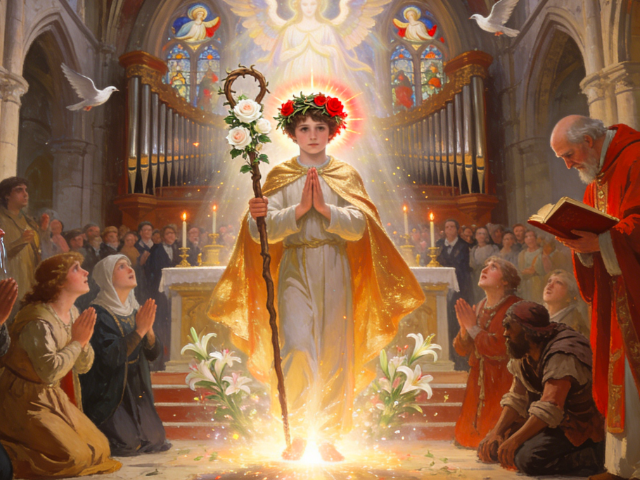
He stood there dressed as a king and the light of heaven filled the place. There was music and singing. The people fell on their knees.
The High Priest laid his hands on the young king’s head. “A greater One than I has crowned you,” he said, and knelt down before him.